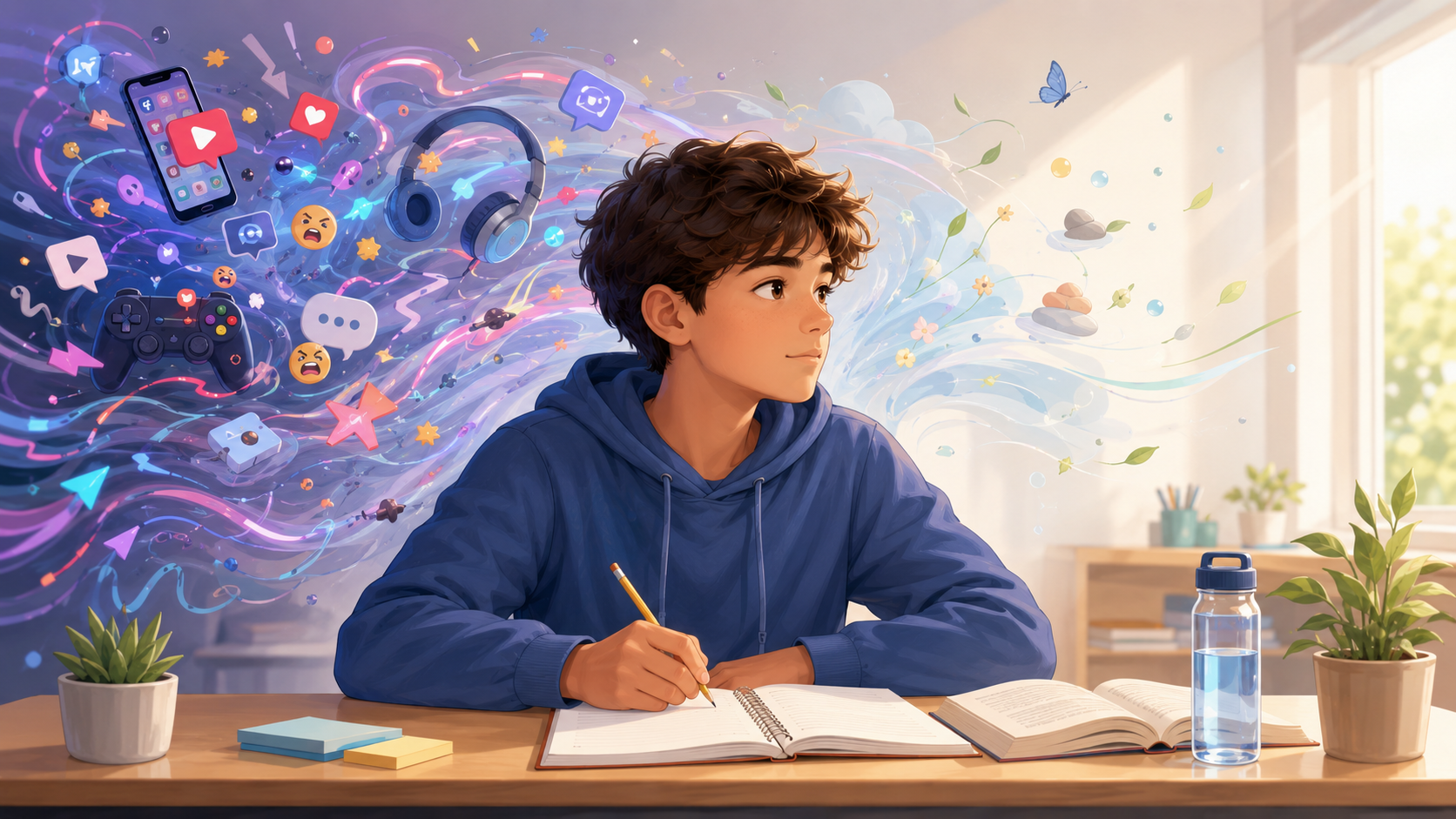
Students do not only need more rules. They need routines, pauses, movement, filters, and a learning culture that helps their nervous system return to attention.
In Fairfield, Iowa, far from the usual image of elite coastal schools, there is a small independent school with an unusual record of achievement.
Its students regularly stand out in fields that require focus, persistence, and deep thinking: science, mathematics, technology, robotics, computer science, and innovation competitions. It is not the kind of school most people would immediately place at the centre of America’s STEM conversation. And yet, year after year, its students appear in serious academic and creative competitions with impressive results.
At first glance, the story sounds familiar.
Perhaps the school has stricter rules. Perhaps the students are simply more disciplined. Perhaps the secret is more homework, more pressure, more testing, or longer hours.
But the rhythm of the school day tells a different story.
The school is Maharishi School in Fairfield, Iowa. Fairfield itself was not founded as a meditation town. It is an older Midwestern town. But since the 1970s, it has also become known as a centre of the Transcendental Meditation community, partly because of Maharishi International University and the wider community that grew around it.
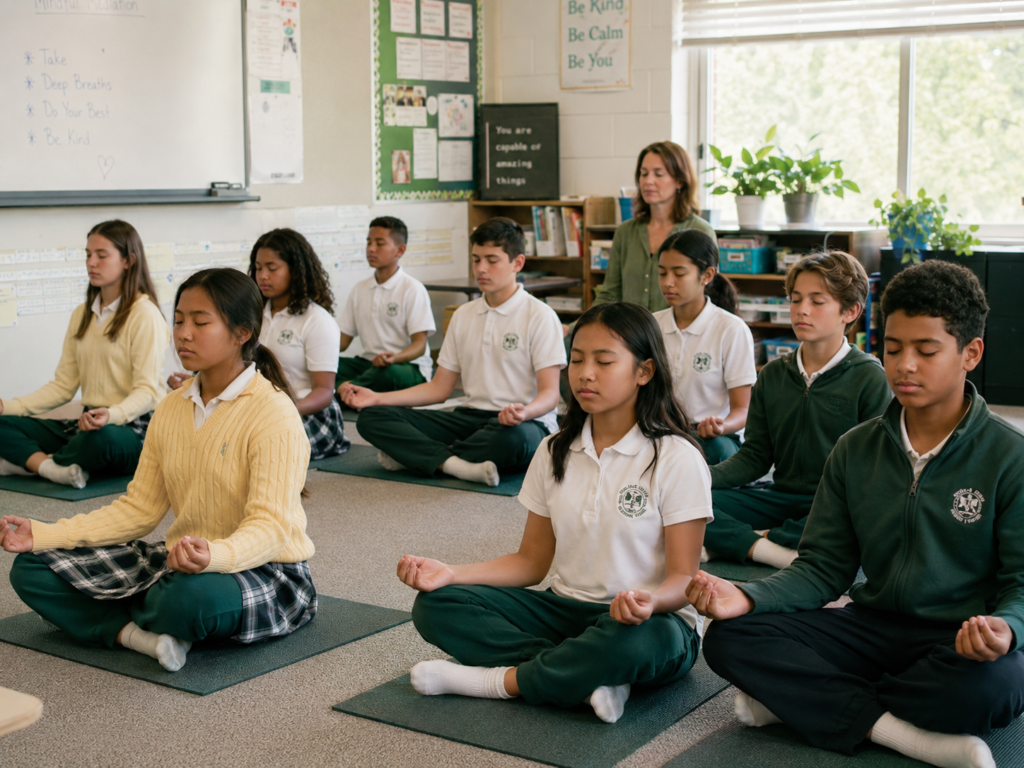
At Maharishi School, students do not begin with more noise, more urgency, or more stimulation. Twice a day, the school makes space for the mind to settle. Students practise Transcendental Meditation and related quiet-time routines as part of the daily schedule.
That detail matters.
Because one of the greatest challenges in education today is not only how to give students more information. It is how to help them recover the calm, focus, and inner stability needed to use information well.
Children Are Not Only Misbehaving. They Are Overstimulated.
When students are restless, distracted, impulsive, loud, or unable to settle, the first explanation is often behaviour.
They are not listening.
They are too excited.
They are not following instructions.
They need to calm down.
Sometimes that is true. But it is not the whole story.
Children today are growing up in a radically different attention environment. Their brains are surrounded by screens, notifications, short videos, games, advertising, social media, constant music, constant images, constant comparison, and constant choice.
Before the school day even begins, many children have already been exposed to more stimulation than previous generations experienced in a whole morning.
This does not mean children are worse than before.
It means the environment around them has changed.
We cannot feed children fast dopamine all day and then be surprised when slow learning feels difficult. We cannot surround them with constant interruption and then expect instant deep focus. We cannot train attention to jump from one stimulus to another and then blame children when they struggle to stay with one task long enough to understand it.
A restless classroom is not always a discipline problem.
Sometimes it is an overstimulation problem.
From Scarcity to Overload

For most of human history, the main problem was scarcity.
People had to find enough food, enough safety, enough warmth, enough reliable information, and enough real connection.
Today, in many parts of the world, the problem has been reversed.
We have too much food, too much information, too much stimulation, too many opinions, too many interruptions, too many artificial rewards, and too many shallow connections.
The baby boom generation was not living like hunter-gatherers, of course. But compared with today’s children, many of them grew up in a much slower information environment: fewer channels, fewer messages, fewer images, fewer screens, fewer interruptions, and much longer periods of boredom, outdoor play, face-to-face interaction, and silence.
Today’s children face a different challenge. They do not only need access to information. They need help choosing which information deserves their attention.
They do not only need entertainment. They need recovery from too much entertainment.
They do not only need connection. They need to learn the difference between real relationships and digital noise.
They do not only need more stimulation. They need the ability to return to themselves.
In an age of overload, education must teach more than knowledge.
It must teach detox, filters, focus, and rhythm.
Detox, Filters, Focus, and Rhythm
The word “detox” is often used too loosely, but in education it can be useful if we understand it simply.
A detox does not mean rejecting modern life. It means reducing what overloads the nervous system.

Children need moments without screens, noise, pressure, comparison, and constant input. They need time to move, breathe, read, build, draw, talk, walk, sit, imagine, and even be bored.
Boredom is not always a problem. Sometimes boredom is the doorway back to attention.
Filters are equally important.
A child who has access to everything does not automatically become wiser. Access is not the same as judgment. Information is not the same as understanding. Stimulation is not the same as learning.
Children need adults to help them filter: What is useful? What is true? What is kind? What is manipulative? What is worth my time? What should I ignore?
Focus is the next step.
Focus is not simply the ability to “pay attention” because an adult demands it. Focus is the ability to stay with one meaningful thing long enough for learning to happen.
And rhythm gives focus a home.
Children settle more easily when the day has predictable patterns: a calm beginning, clear transitions, movement, focused work, social time, quiet moments, and a known way to return from excitement to attention.
Rules matter.
But rhythm often works better than repeated correction.
What Families Can Do at Home
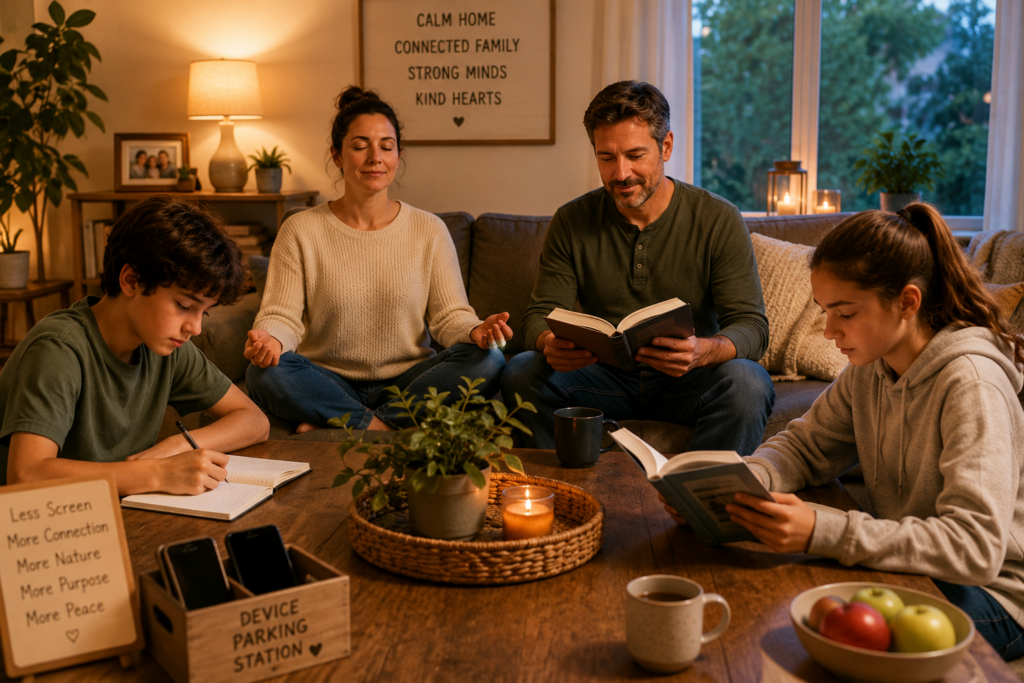
Schools cannot solve overstimulation alone. A child’s attention is shaped long before they enter the classroom.
At home, the first step is to protect sleep.
Screens before bedtime make it harder for many children to settle. Notifications, games, videos, and emotional online content keep the brain active when it should be preparing for rest. A simple family rule can help: no screens in the bedroom, and no screens during the final part of the evening routine.
The second step is to protect meals.
A meal without phones is not only about nutrition. It is about conversation, eye contact, listening, and belonging. Children need real human connection that is not interrupted by a screen on the table.
The third step is to protect homework from multitasking.
Homework done beside a phone is not the same as homework done with full attention. Even if the phone is not being used, its presence can invite interruption. A simple focus space, even for twenty minutes, can make a difference.
The fourth step is to bring back movement.
Children are not designed to sit still all day and then sit still all evening. Walking, cycling, sports, outdoor play, dancing, climbing, and simple physical work help the body discharge stress and prepare the mind for calmer attention.
The fifth step is to make room for boredom.
Parents do not need to fill every empty moment. Some of the child’s creativity begins when no one is entertaining them.
A calmer child is not created by one rule.
A calmer child is created by a home rhythm that does not constantly overstimulate the nervous system.
What Schools Can Do Long-Term
Schools also need to rethink the attention environment.
The first long-term question is phones.
Every school needs a clear and consistent policy. It is not enough to say that phones are allowed “when used responsibly” if students are not yet developmentally ready to resist constant distraction. A phone can be a useful tool, but it can also be an attention leak in the middle of the school day.
The second question is screen balance.
Technology can support learning, but it should not replace every slower, deeper, human activity. Children still need handwriting, reading on paper, discussion, physical materials, outdoor learning, drawing, building, experimenting, and face-to-face collaboration.
The third question is quiet time.
This does not have to mean Transcendental Meditation. It can be silent reading, breathing, reflective writing, mindful sitting, calm music, prayer in religious schools, or a short period of stillness. The method can vary. The principle is simple: the school day should include moments where the nervous system is allowed to settle.
The fourth question is movement.
A school that expects children to sit for long periods without movement will produce restlessness. Short movement breaks, outdoor time, active learning, stretching, walking discussions, and physical education are not luxuries. They are part of attention design.
The fifth question is environment.
A classroom full of visual clutter, harsh noise, constant announcements, echo, bright screens, and rushed transitions makes calm harder. Schools should think of attention as something the environment either supports or destroys.
A school culture that protects focus is not anti-technology.
It is pro-learning.
15 Simple Ways Teachers Can Calm Students and Rebuild Focus
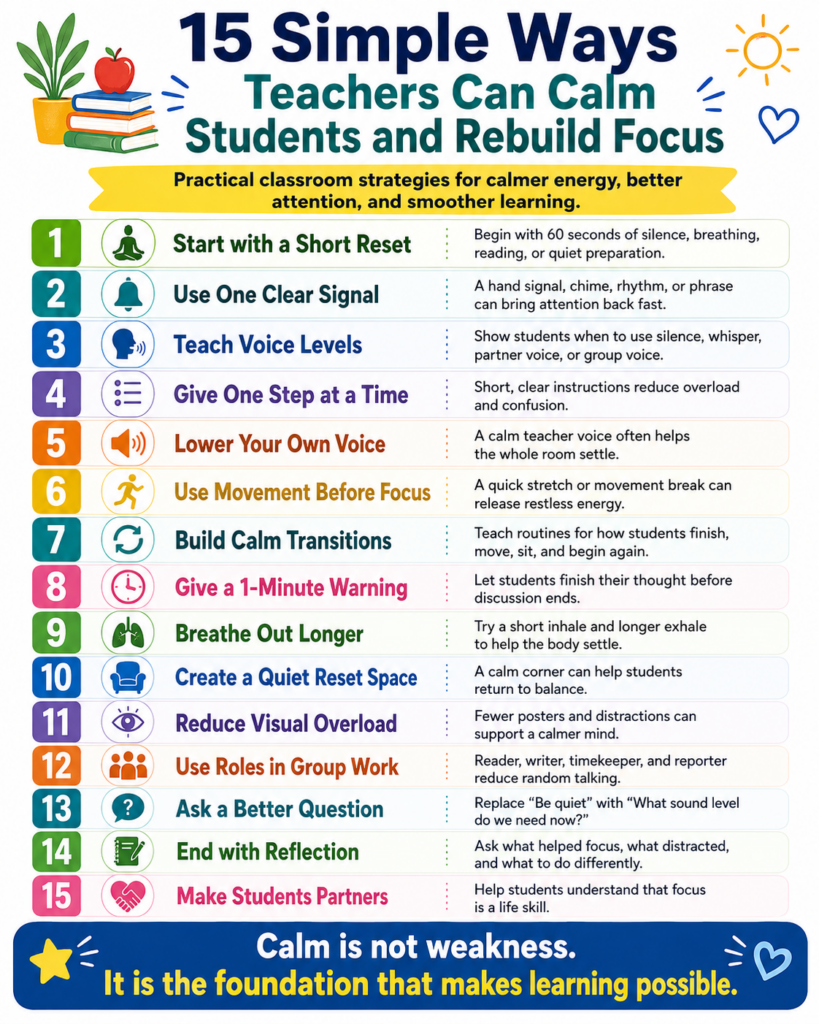
Teachers cannot redesign society in one lesson. But they can influence the rhythm of the classroom immediately.
Here are fifteen simple ways to help students settle without killing energy, curiosity, or collaboration.
1. Start with a short reset
Begin the lesson with sixty seconds of silence, breathing, reading, or quiet preparation. Do not wait for chaos to begin before introducing calm. Make calm the entry point.
2. Use one clear attention signal
A raised hand, a chime, a rhythm, a light signal, or a short phrase can bring students back without shouting. The key is consistency. Students should know exactly what the signal means and what they should do when they hear or see it.
3. Teach voice levels explicitly
“Be quiet” is too vague. Teach different sound levels: silence, whisper, partner voice, group voice, presentation voice. Then connect each level to a type of activity.
4. Give one instruction at a time
Overstimulated students often lose long instructions. Give one step, check understanding, then continue. Clarity reduces noise.
5. Lower your own voice
A teacher who speaks louder and louder often pulls the room upward. A calm, lower voice can sometimes draw students back more effectively than shouting.
6. Use movement before focus
If students are physically restless, a short movement break may be faster than repeated warnings. Thirty seconds of standing, stretching, walking, or shaking out energy can prepare the body for attention.
7. Build calm transitions
Transitions are often louder than the lesson itself. Teach them as routines: finish, close, stand, move, sit, begin. Repeat the same structure until it becomes automatic.
8. Give a warning before stopping discussion
Do not suddenly cut off every conversation. Say, “You have one minute to finish your sentence.” This lowers resistance and helps students land the activity properly.
9. Use breathing with a longer exhale
A simple breathing pattern can help: inhale for three, exhale for five. The longer exhale signals the body to settle. Keep it short and natural.
10. Create a quiet reset space
A calm corner, reading chair, reflection desk, or small reset area can help students who need a moment to return to balance. It should not feel like punishment. It should feel like regulation.
11. Reduce visual overload
Too many posters, colours, unfinished displays, and moving images can make the room feel busy. A calmer wall can support a calmer mind.
12. Use roles during group work
Noise rises when students do not know what they are supposed to do. Assign roles: reader, writer, timekeeper, materials manager, reporter. Structure reduces random talking.
13. Replace “Be quiet” with a better question
Ask, “What sound level do we need for this task?” This helps students connect behaviour with purpose instead of simply obeying an order.
14. End with reflection
A one-minute written or spoken reflection helps students close the learning loop: What did I learn? What helped me focus? What distracted me? What should I do differently next time?
15. Make students partners in focus
Talk openly about attention. Explain that focus is not only a school rule. It is a life skill. Students are more likely to cooperate when they understand why calm matters.
Calm Is Not Weakness
Some people worry that calming students means making the classroom passive.
But calm is not passivity.
Calm is the foundation that allows energy to become useful.
A calm student can listen better, think deeper, collaborate more respectfully, and recover faster from frustration. A calm classroom is not a classroom without life. It is a classroom where life has direction.
The goal is not to turn children into silent machines.
The goal is to help them become capable of attention in a world designed to steal it.
Modern education cannot only ask, “How do we deliver more information?” It must also ask, “How do we help children become strong enough, calm enough, and focused enough to use information well?” Because in an overstimulated world, focus is no longer automatic.
It has to be taught.
It has to be protected.
Stay curious.