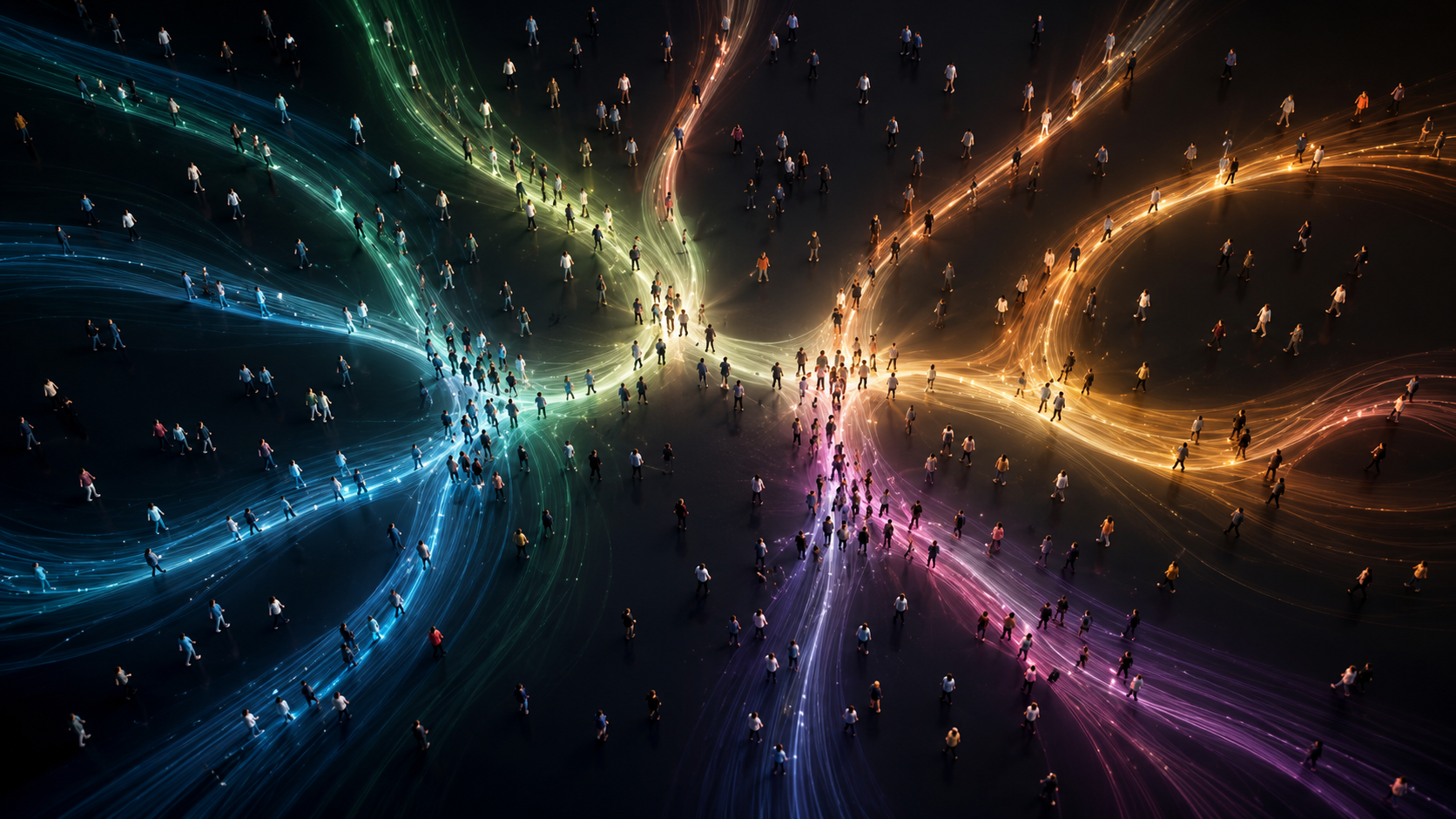
Designing Environments Where Better Behavior Emerges Naturally
Why We Keep Solving the Wrong Problem
When children become noisy in a school cafeteria, we blame discipline. When patients become frustrated in a hospital, we blame staff shortages. When workers lose productivity, we blame motivation. When visitors complain about long queues, we blame demand.
But what if the real problem is neither people nor demand?
What if the problem is flow?
Many of the world’s best-performing systems – from airports and hospitals to Disney parks and manufacturing plants – have discovered a surprisingly simple truth:
Stress emerges where flows collide. Performance grows where flows are clear, predictable, and natural.
People behave better when systems flow better.
Temple Grandin’s Unexpected Lesson
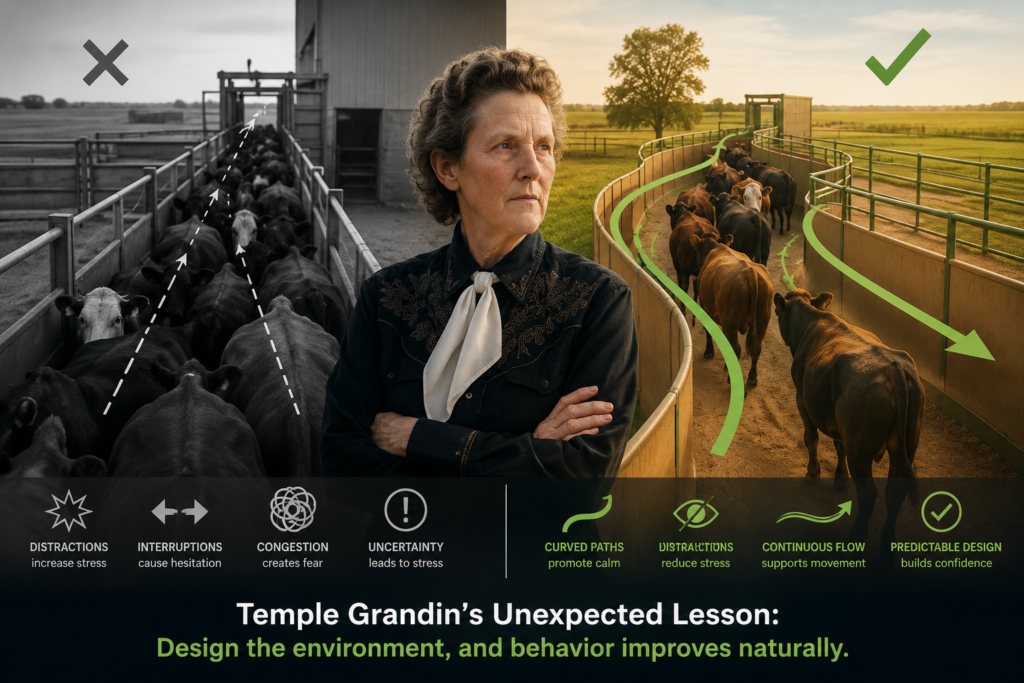
One of the most fascinating examples comes from Temple Grandin.
Grandin is an American scientist, professor, and one of the world’s leading experts on animal behavior. She became famous for redesigning livestock handling systems used on farms and ranches around the world.
Temple Grandin is also autistic and has often described her ability to think in pictures rather than words. She has explained that this allowed her to notice environmental details and sensory experiences that many others overlooked. Her unique perspective helped her understand how animals perceive movement, light, noise, shadows, and obstacles.
What made her work remarkable was that she approached the problem differently. Rather than trying to force animals to behave differently, she redesigned the environment.
She carefully observed how animals perceive movement, space, light, noise, and obstacles. She discovered that many behaviors people considered “stubbornness” or “resistance” were actually reactions to stress, confusion, and poor environmental design.
Animals moved more calmly when:
- pathways were curved instead of straight,
- distractions were hidden,
- movement was continuous,
- bottlenecks were removed,
- they could not see confusing activity ahead.
Curved chutes consistently outperformed straight ones because animals focused on movement rather than distractions at the destination. This insight may sound unrelated to human organizations – it is not.
The principle is universal:
When movement feels natural, stress decreases. When movement becomes interrupted, confusing, or unpredictable, stress rises.
Whether we are moving cattle through a ranch, passengers through an airport, patients through a hospital, or students through a school cafeteria, the same principle applies:
People and animals behave differently when systems flow differently.
The Hidden Cost of Intersections
Imagine a school lunch break. Several hundred students leave classrooms simultaneously.
Some are going to lunch.
Some are returning.
Some are heading to the restroom.
Teachers are crossing the same corridors.
Younger and older students mix together.
Parents arrive.
Visitors enter.
Deliveries pass through.
At every crossing point, friction emerges.
Noise rises.
Waiting increases.
Conflicts become more likely.
Most schools respond with more supervision.
Few respond with better flow design.
Airports Solved This Long Ago
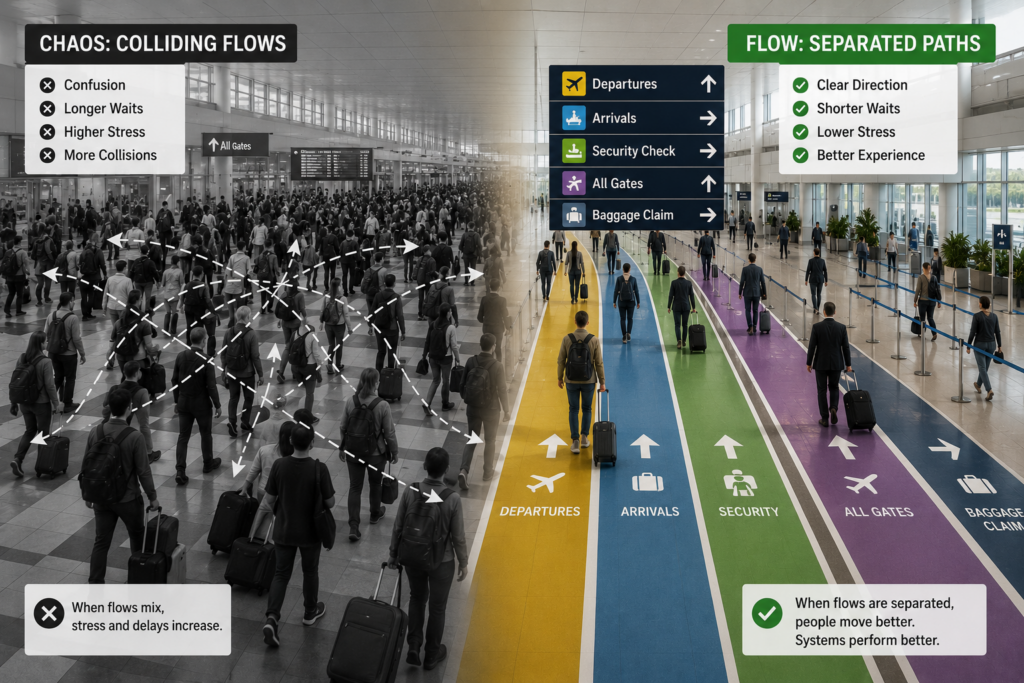
Modern airports separate flows relentlessly.
- Arrivals.
- Departures.
- Security-cleared passengers.
- Non-cleared passengers.
- Staff.
- Baggage.
- VIP passengers.
Each group follows a different path.
The goal is simple:
Prevent unnecessary intersections.
Airports learned that every unnecessary interaction increases confusion, delays, and stress.
Schools rarely think this way.
Perhaps they should.
The same principle applies to hospitals, factories, shopping centers, and office buildings.
The fewer unnecessary collisions between people, activities, and objectives, the smoother the system becomes.
Disney’s Secret: People Experience Journeys, Not Minutes
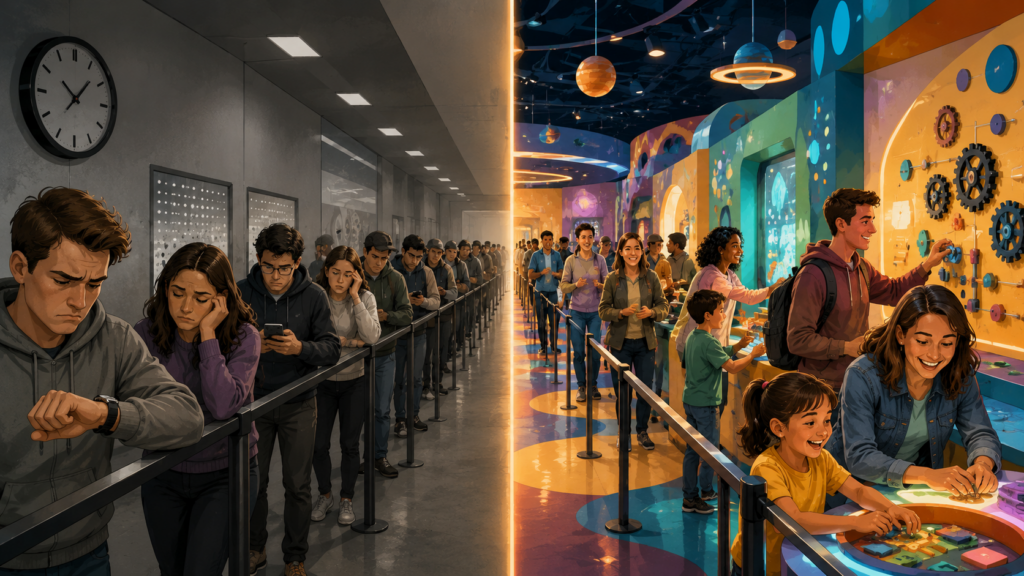
One of the most overlooked principles in system design is that people do not experience time objectively.
They experience it psychologically.
Marketing expert Rory Sutherland often uses a fascinating example from the British railway system.
Governments have spent billions trying to reduce travel times by a few minutes. Yet Sutherland argues that there is another option.
Instead of making the journey shorter, make it more enjoyable. A train ride that feels interesting, comfortable, engaging, or productive may be perceived as shorter even if the actual travel time remains exactly the same.
His famous joke is that it might be cheaper to hire supermodels to walk through the train serving complimentary drinks than to spend billions on infrastructure improvements that save only a few minutes.
Behind the joke lies a serious insight:
People do not measure minutes. They measure experiences.
Disney understands this principle exceptionally well.
Visitors spend hours in queues, yet many leave satisfied because Disney transforms waiting into part of the experience.
Stories unfold.
Characters appear.
Interactive elements engage visitors.
Progress feels visible.
The queue becomes part of the attraction.
The lesson for schools, hospitals, factories, and public services is profound. Sometimes the best solution is not to eliminate waiting. Sometimes the better solution is to redesign the waiting experience.
A school lunch queue can become a learning opportunity.
A hospital waiting room can reduce anxiety through information and transparency.
A factory can reduce perceived delays by making workflow visible.
A transport system can make travel time feel productive rather than wasted.
Because in human systems, perceived time is often more important than clock time.
The Theory of Constraints
Another powerful insight comes from Eliyahu Goldratt, the creator of the Theory of Constraints.
Goldratt argued that most systems are not limited by everything. They are limited by one thing.
A constraint.
A bottleneck.
Consider the image below.
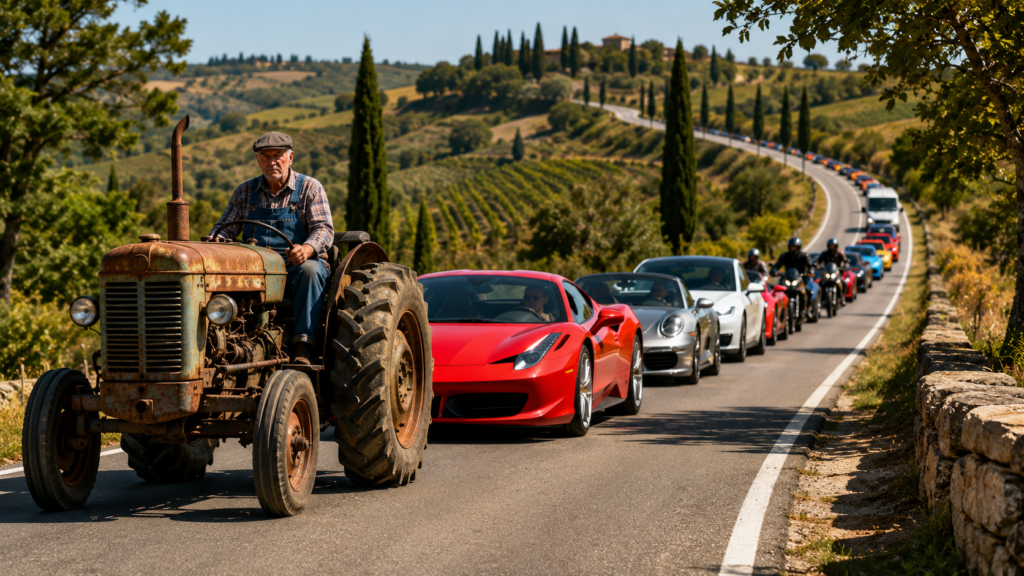
The lesson is surprisingly simple.
The speed of the system is not determined by its strongest parts.
It is determined by its weakest constraint. The sports cars behind the tractor may be capable of traveling three or four times faster. It does not matter. As long as overtaking is impossible, every vehicle in the line is forced to move at the tractor’s pace.
Organizations work the same way.
Schools work the same way.
Hospitals work the same way.
Factories work the same way.
A school may believe its cafeteria is too small.
But perhaps only one doorway is too narrow.
Perhaps one serving station creates the entire queue.
Perhaps all grades arrive within the same three-minute window.
Perhaps a staircase is the real bottleneck.
The solution is not always more capacity. Often it is simply identifying and relieving the constraint that governs the entire flow.
As Goldratt taught:
A system does not move at the speed of its best performers. It moves at the speed of its constraint.
Lean Thinking: Remove the Waste
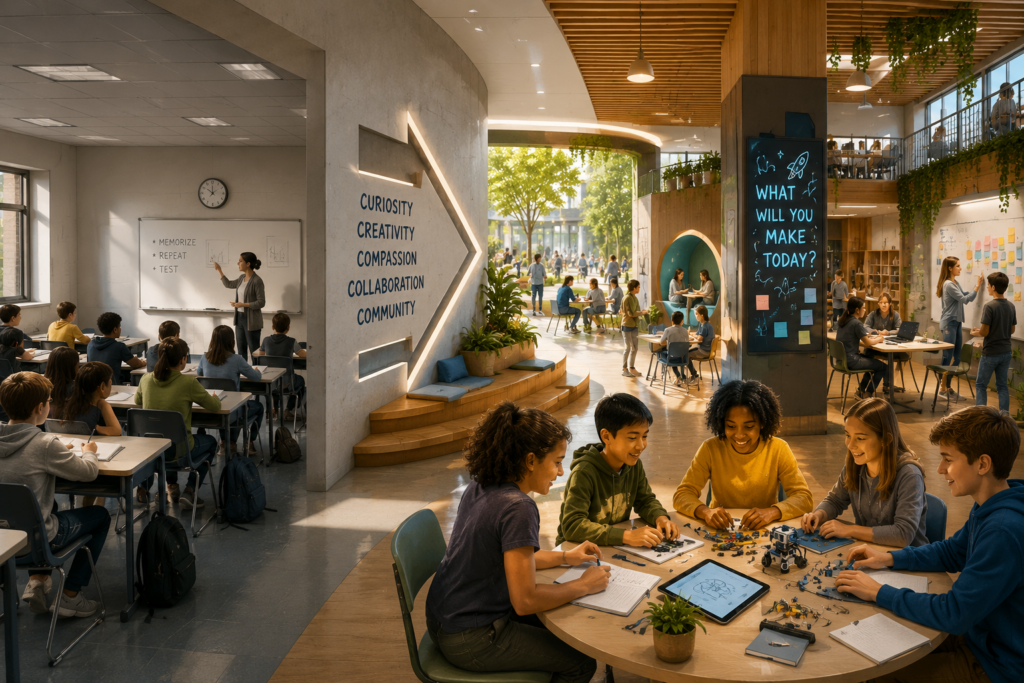
Lean thinking identifies several forms of waste.
Two are especially relevant:
- waiting,
- unnecessary movement.
Most organizations accept both as normal.
They should not.
Every unnecessary stop consumes attention.
Every unnecessary walk consumes energy.
Every unnecessary queue consumes patience.
Ask simple questions:
- How many times does a student stop?
- How many times must they turn around?
- How many times do they need to wait?
- How many times do they cross another flow?
Every stop creates friction.
Every friction point creates stress.
When organizations remove unnecessary movement and waiting, performance often improves without requiring people to work harder.
What Schools Could Do Tomorrow
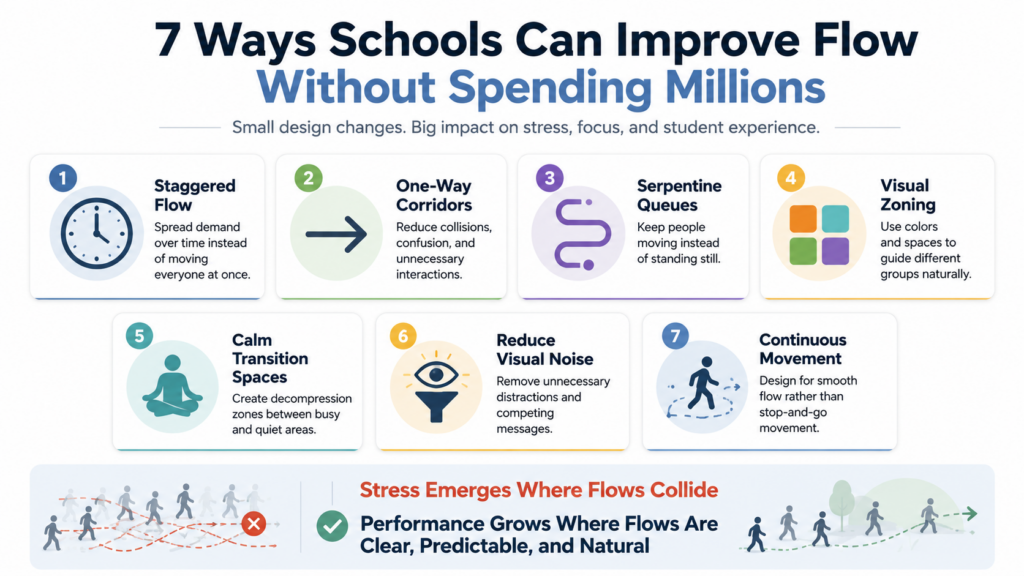
Many improvements require little or no investment.
1. Staggered Flow
Most schools still operate as if they were factories from the industrial age.
One bell rings.
Everybody moves.
At exactly the same time.
The result is predictable:
crowded hallways,
long queues,
noise,
stress,
and wasted time.
But we no longer live in the age of mechanical bells.
We live in the age of digital systems.
There is no reason why every grade must start, finish, eat lunch, or take breaks at exactly the same moment.
A five-minute offset between age groups can dramatically reduce congestion.
In some situations, each grade could have its own schedule.
In others, each classroom could operate on a slightly different rhythm.
The benefits go beyond reducing noise and crowding.
When demand is distributed over time, the same cafeteria can serve more students.
The same facilities can accommodate more users.
The same staff can provide better service.
In other words, better timing often creates the equivalent of additional capacity—without building anything new.
2. One-Way Corridors
Use IKEA-style movement patterns during peak times.
Fewer collisions.
Less confusion.
Lower noise.
Safer movement.
3. Spiral or Serpentine Queues
Avoid long straight lines.
People perceive progress better when movement is continuous.
A gently curved or serpentine queue often feels shorter and calmer than a rigid straight line.
4. Visual Zoning
Different colors for different age groups.
Different routes.
Different entrances.
Different gathering spaces.
Less confusion.
Less conflict.
5. Calm Transition Spaces
Create “decompression zones” between classrooms and cafeterias.
Students shift mentally before entering a crowded environment.
The transition itself becomes part of the design.
6. Eliminate Visual Noise
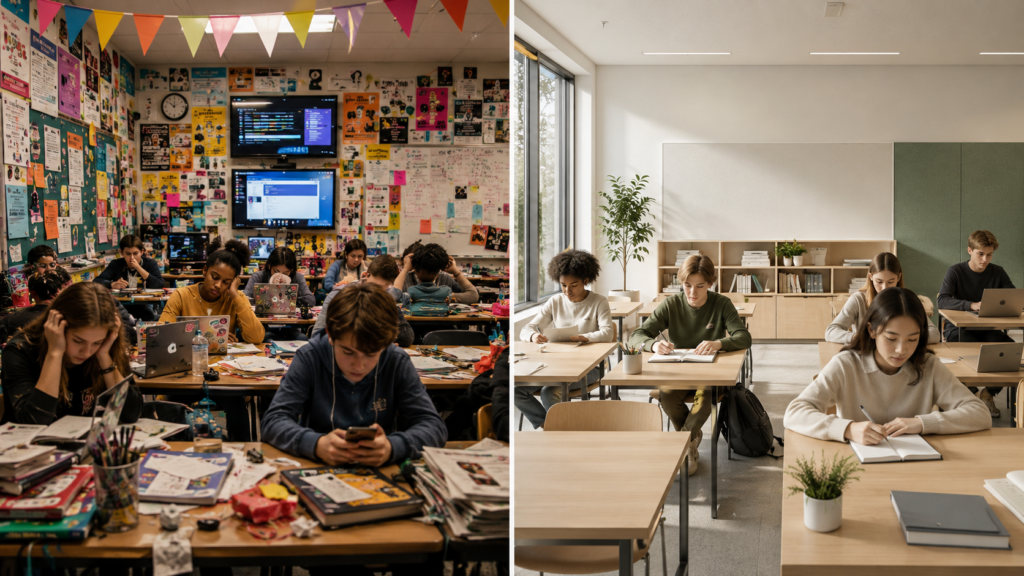
Temple Grandin discovered that unnecessary visual distractions increase stress, hesitation, and confusion.
Humans are not so different.
Too many signs.
Too many announcements.
Too many competing messages.
Too many colors.
Too many screens.
Too many notifications.
The challenge is even greater today than it was a generation ago.
For more than 200,000 years, humans lived as hunters and gatherers in environments where information was relatively scarce and highly relevant. Today we live in an age of abundance.
Abundance of food.
Abundance of products.
Abundance of entertainment.
Abundance of choices.
Abundance of books.
Abundance of videos.
Abundance of games.
Abundance of services.
And, of course, abundance of information.
For the first time in human history, scarcity is no longer the primary challenge for many people.
Filtering is.
Focusing is.
Choosing is.
As a result, modern life requires a new skill:
the ability to ignore,
the ability to filter,
the ability to focus.
Unfortunately, many schools and workplaces unintentionally add to the overload.
Walls filled with posters.
Crowded notice boards.
Constant announcements.
Visual clutter.
Competing priorities.
Instead of helping people focus, the environment competes for their attention.
Human Flow Architecture suggests a different approach.
The purpose of architecture, interior design, signage, decoration, and communication should not be to add more information.
It should be to reduce unnecessary information.
A well-designed environment acts as a filter.
It quietly guides attention toward what matters and removes distractions that do not.
In an overstimulated world, clarity is no longer a luxury. It is a performance tool.
7. Design for Continuous Movement
The goal should not be faster movement.
The goal should be smoother movement.
People tolerate movement.
People hate standing still.
Beyond Flow: Designing Better Learning Environments
Flow is only one part of the equation.
The way people move through a space affects stress and performance, but so do sound, attention, and the visual environment.
If you are interested in creating calmer and more effective learning environments, you may also enjoy:
How to Reduce Classroom Noise and Improve Learning Without Killing Collaboration
How to Calm Students and Rebuild Focus in an Overstimulated World
What began as an observation about school cafeterias quickly revealed something larger.
The same principles appear in schools, hospitals, airports, factories, offices, and even cities.
They influence how people move, communicate, focus, collaborate, and make decisions.
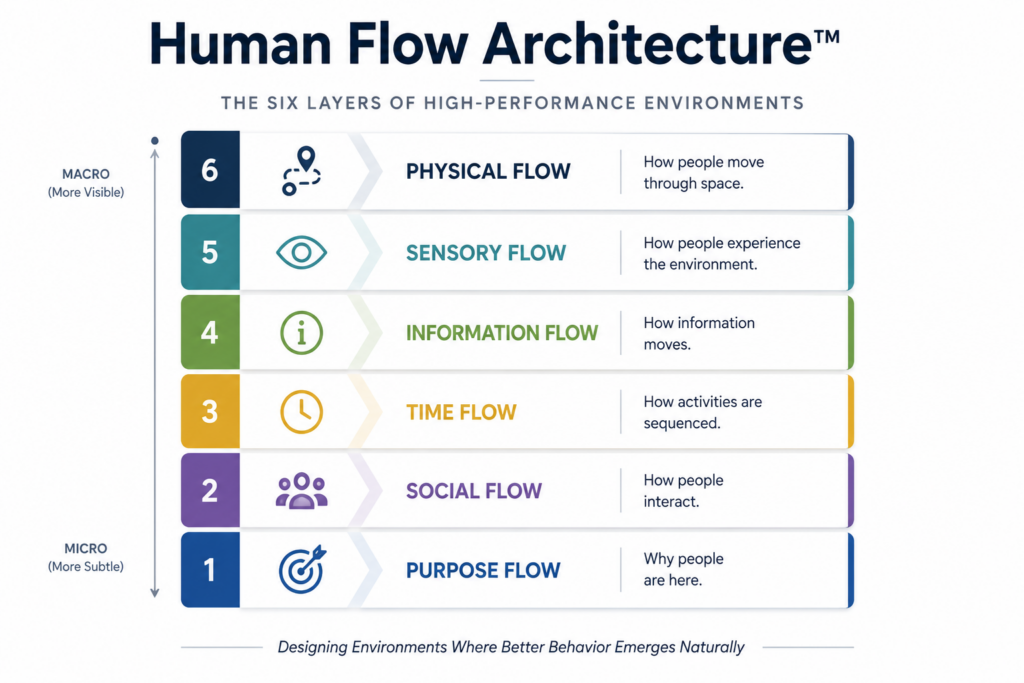
We are beginning to explore these patterns under a broader concept called Human Flow Architecture™ – the study of how space, time, information, sensory stimuli, and social interactions shape human behavior and performance. Future articles will explore these dimensions in greater depth.
Conclusion
What fascinates me is that the same principle appears everywhere.
Temple Grandin discovered it in livestock systems.
Lean practitioners discovered it in factories.
Goldratt discovered it in production management.
Disney discovered it in entertainment.
Airports discovered it in transportation.
Hospitals discovered it in healthcare.
Different industries. Different problems. Different languages.
The same principle.
Flow reduces stress.
Perhaps the future of schools is not more rules.
Perhaps the future of hospitals is not more staff.
Perhaps the future of organizations is not more control.
Perhaps the future lies in designing environments where the desired behavior emerges naturally.
Because people do not experience systems.
They experience journeys through systems.
And when those journeys are clear, predictable, and natural, people stop fighting the system.
When people stop fighting the system, performance improves almost by itself.
Stress emerges where flows collide. Performance grows where flows are clear, predictable, and natural.
That is the essence of Human Flow Architecture.
Stay curious.