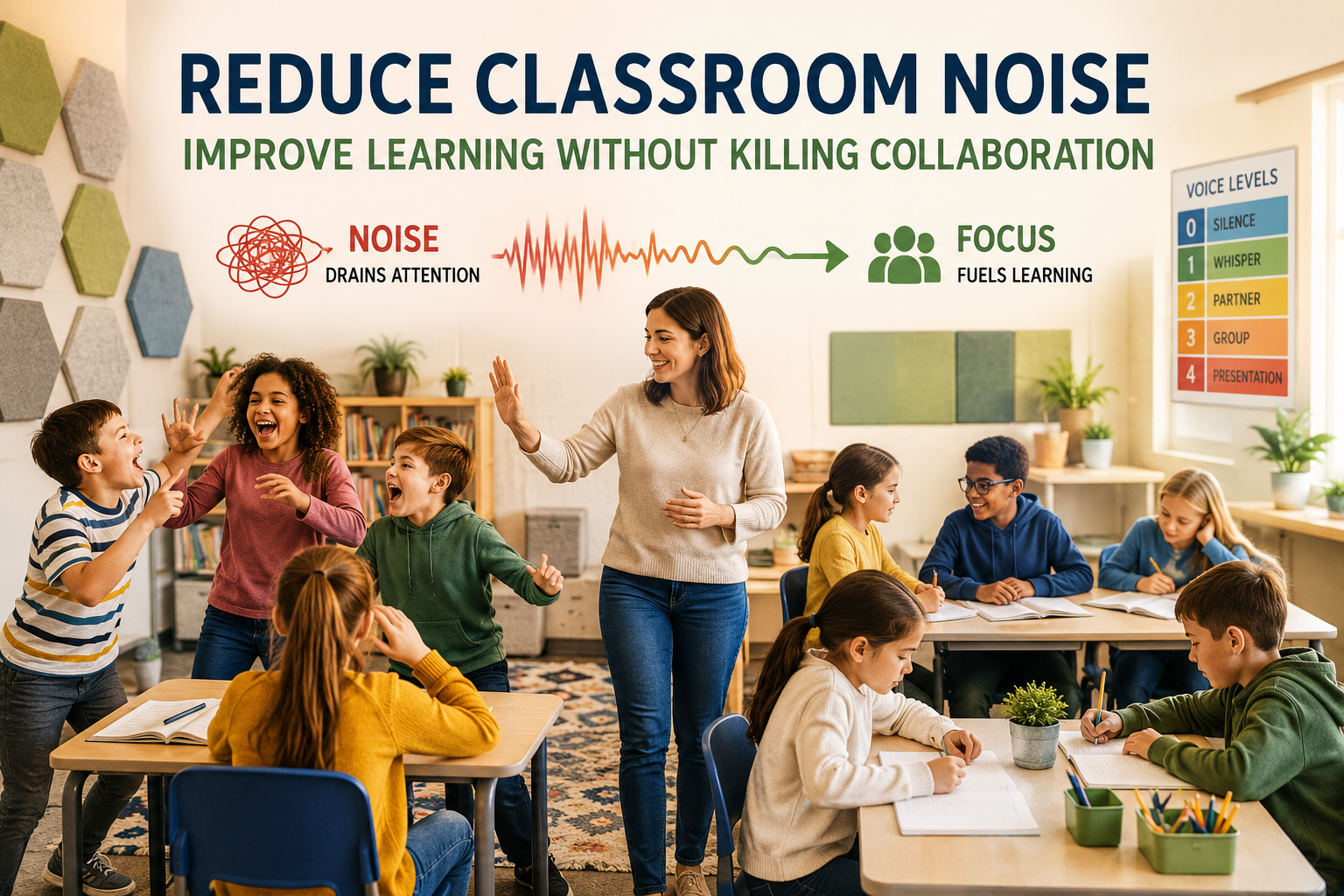
A classroom does not need to be silent to be effective. But it does need a sound environment that helps students listen, think, and participate.
A teacher who spends the whole day speaking over noise becomes tired more quickly. Their voice is strained. Their patience is tested. Their ability to notice quiet students, respond calmly, and guide the room with confidence becomes harder.
When a student tries to listen in a noisy classroom, the brain has to work harder.
It must separate the teacher’s voice from background sound. It must ignore chair movement, whispers, hallway noise, and other conversations. It must fill in missing words when instructions are unclear.
That effort uses attention.
And attention is not unlimited.
The more energy students spend filtering noise, the less energy they have left for understanding, remembering, reading, solving problems, and participating. This is especially important for younger children, students sitting farther from the teacher, students with hearing difficulties, students with attention challenges, children with sensory sensitivity, and students learning in a second language.
For them, a noisy classroom is not just uncomfortable. It can become an invisible barrier to learning.
The same is true for teachers.
A noisy classroom does not only make teaching louder.
It makes thinking harder.
The Goal Is Not Silence
A good classroom is rarely completely silent.
There are questions, short discussions, group tasks, chairs moving, pencils falling, notebooks opening, and students explaining ideas to one another. That is not a failure of classroom management. That is learning in motion.
The problem begins when sound stops supporting learning and becomes noise.
The point is not to create a silent classroom. The point is to create a classroom sound environment that supports learning – instead of noise that drains attention, working memory, teacher energy, and children’s patience.
This is an important distinction.
If we treat every sound as a problem, we may kill collaboration. But if we ignore noise, collaboration can easily become chaos. The best classrooms do not eliminate sound. They organize it.
Noise Is Not Only a Behaviour Problem
When a class becomes too loud, the first explanation is often behaviour.
Students are not listening. They are too excited. They are not following instructions. They need to calm down.
Sometimes that is true. But often, it is only part of the story.
Classroom noise also comes from the room itself: hard floors, empty walls, scraping chairs, echo, open doors, corridors, nearby classrooms, ventilation systems, outdoor noise, and poorly arranged furniture. A classroom full of hard surfaces reflects sound. A poorly planned layout allows one group’s conversation to disturb another group’s focus. Unclear routines make every transition louder than it needs to be.
In other words, noise is not created only by children.
It is also created by design.
That means reducing classroom noise should not begin with the question, “How do I make students quiet?”
A better question is:
How do we design the space, routines, and expectations so that sound supports the type of learning we want?
Productive Sound vs. Destructive Noise
Sound is not the enemy of learning.
Students need to speak, ask, explain, challenge, collaborate, read aloud, and test ideas. A classroom where nobody ever talks is not necessarily a better classroom. It may simply be a passive one.
The real issue is whether the sound has a purpose.
Productive sound is connected to learning. It happens when students discuss a task, solve a problem together, explain their thinking, ask relevant questions, or participate at an agreed voice level.
Destructive noise is different. It happens when voices compete, instructions become unclear, one group disturbs another, background sounds interrupt concentration, or the room’s acoustics make every sound louder and longer than it should be.
The goal is not less life in the classroom.
The goal is more intentional sound.
How to Improve Classroom Acoustics With Minimal Investment
Many improvements do not require renovation.
Small physical changes can reduce unnecessary noise and make the classroom warmer, calmer, and more beautiful at the same time.
Start with the sounds that happen many times every day.
Chairs scraping across the floor may seem like a small problem, but it happens again and again. Chair caps, felt pads, or rubber glides can make a surprising difference. They reduce sharp, irritating sounds and make transitions less disruptive.
Soft materials also help. Rugs, curtains, cushions, cork boards, fabric display boards, bookshelves, plants, and soft seating can make a room feel less harsh. They do not only decorate the classroom. They help absorb sound and reduce the echo created by hard surfaces.
Walls can also be used more intentionally. Empty walls often reflect sound. Display boards, student work, felt panels, acoustic boards, or fabric-covered surfaces can make the room both more personal and more acoustically friendly.
The aim is not to turn the classroom into a recording studio. The aim is to remove the small, repeated noises that constantly steal attention.
A quieter classroom can also be a more beautiful classroom.
10 Simple Ways Teachers Can Reduce Noise Without Killing Energy
Teachers can influence classroom noise immediately, even without changing the room.
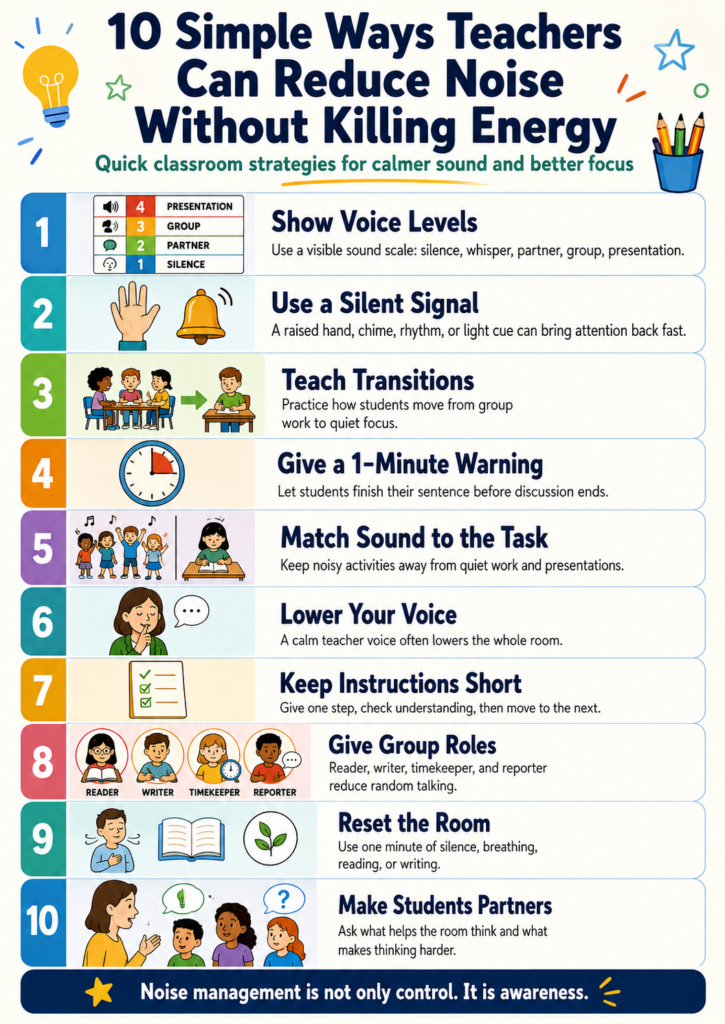
The first step is to make sound levels visible. Students often do not know what “quiet” means in a practical sense. A simple voice-level chart can help: silence, whisper, partner voice, group voice, presentation voice. When the expected level is visible, it becomes easier to correct behaviour without long explanations.
Second, use a non-verbal signal for attention. A raised hand, a chime, a rhythm, a light signal, or a short repeated phrase can bring the class back without shouting over the noise.
Third, teach transitions as routines. Moving from group work to individual work is often one of the loudest moments in the classroom. A short countdown, a clear instruction, and a repeated routine can prevent the transition from becoming a noise wave.
Fourth, give students a warning before ending discussion. “You have one minute to finish your sentence” is much better than suddenly demanding silence. It respects the conversation and lowers resistance.
Fifth, separate noisy and quiet tasks. If one group is presenting, another group should not be doing a high-energy activity nearby. The room should match the learning activity.
Sixth, lower your own voice when possible. When the teacher always speaks loudly, students often raise their own volume. A calm, lower voice can sometimes pull the room down more effectively than shouting.
Seventh, use short instructions. Long instructions in a noisy room are easily lost. Give one step, check understanding, then move to the next step.
Eighth, assign clear roles during group work. When students know who is reading, writing, timing, reporting, or managing materials, there is less random talking.
Ninth, create a quiet reset routine. This can be one minute of silent reading, breathing, writing, stretching, or simply sitting in calm focus. The class needs a known way to return to balance.
Tenth, involve students in noticing noise. Ask them when the room helps them think and when it makes thinking harder. When students understand the purpose, they are more likely to cooperate.
Noise management is not only control. It is awareness.
Building Better Habits and a Classroom Sound Culture
The deeper solution is not one trick. It is a culture.
A classroom sound culture means students understand that different activities need different sound levels. A debate does not sound like silent reading. A science experiment does not sound like independent writing. A presentation does not sound like partner revision.
Instead of expecting one universal level of quiet, the teacher creates clear “sound modes” for different types of learning.
For example:
During individual work, the room is calm and focused.
During partner work, students use a low voice.
During group work, discussion is allowed but controlled.
During presentations, everyone listens.
During transitions, movement is calm and purposeful.
This helps students connect sound with purpose.
It also reduces the need for constant correction. Instead of saying “Be quiet” again and again, the teacher can ask, “Which sound level are we using now?” or “Does the room sound like group work or like free time?”
That small shift matters.
It moves the classroom from control to shared responsibility.
How Schools Can Reduce Noise With a Small Investment

Some noise problems cannot be solved by the teacher alone.
If the classroom has too much echo, if sound travels easily from hallways, if chairs scrape loudly all day, if several classes disturb each other, or if students with sensory needs become overwhelmed, then the school should treat acoustics as part of the learning environment.
This does not always mean expensive reconstruction.
A school can begin with simple steps: chair caps across classrooms, felt pads on tables, rubber stops on doors, soft notice boards, rugs in reading areas, curtains where appropriate, and better use of shelves or storage units to break up sound.
The next level is targeted acoustic treatment.
Acoustic wall panels, ceiling panels, mobile dividers, or sound-absorbing boards can reduce reverberation and make speech clearer. These elements can also be visually attractive. They can bring colour, warmth, and identity into the classroom while improving the sound environment.
This is especially important in nurseries, early years classrooms, language classrooms, music rooms, dining areas, and classrooms used by students with additional needs.
The school does not need to solve everything at once.
It can start with the noisiest rooms, the most echoey spaces, or the areas where teachers report the most vocal fatigue and student distraction.
Better acoustics are not a luxury.
They are part of better learning design.
A Better Sound Environment Is a Better Learning Environment
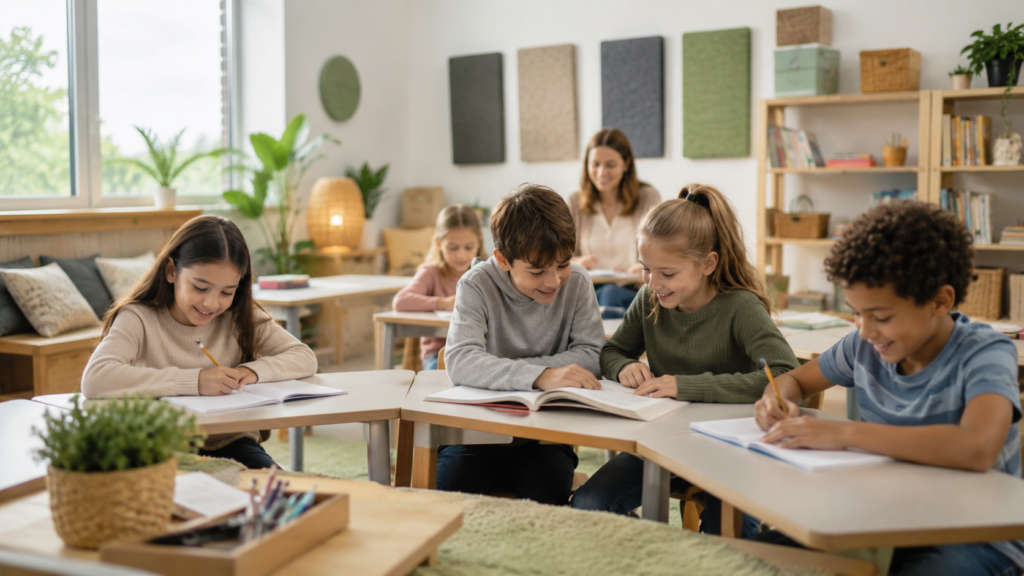
Reducing classroom noise is not about making children silent.
It is about helping them think.
It is about protecting attention, improving speech clarity, reducing unnecessary stress, and making collaboration more effective. It is about creating a room where students can participate without overwhelming one another, and where teachers can guide learning without fighting the sound of the space.
The best classrooms are not dead quiet.
They are calm enough for focus, alive enough for collaboration, and clear enough for every child to understand what is happening.
Because when the sound environment improves, the learning environment improves with it.
Stay curious.