How Modern Food Steals Children’s Focus?
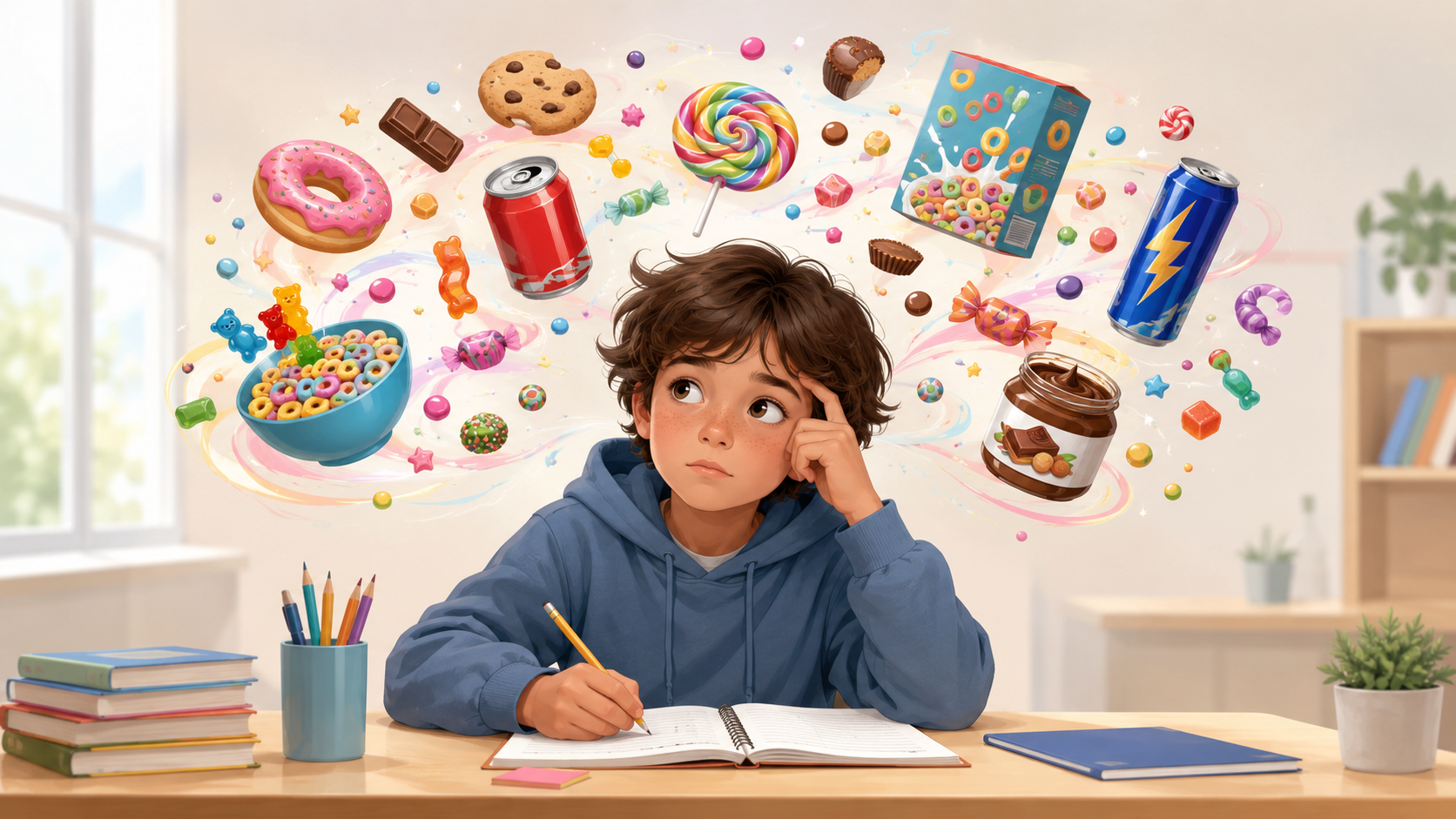
Children do not only need less screen time. They also need fewer edible distractions: sugar-loaded breakfasts, sweet drinks, ultra-processed snacks, and energy drinks that keep the nervous system chasing the next reward.
In one famous laboratory experiment, rats were given a choice between two rewards: intravenous cocaine or intensely sweetened water.
Most people would expect cocaine to win.
It did not.
The Rats That Chose Sweetness Over Cocaine – Why?
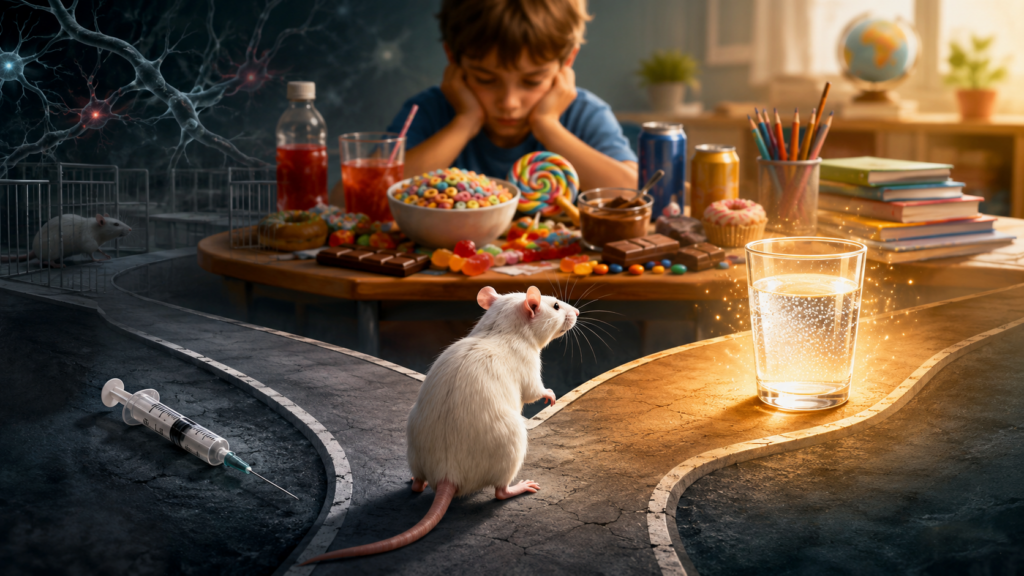
In that study, 94% of the rats preferred the sweetened water over cocaine.
That number is shocking, but it needs to be understood carefully. It does not mean sugar is the same as cocaine in humans. It does not mean a child eating candy is “on drugs.” But it does reveal something important: sweetness is not a neutral taste. It is a powerful reward signal.
The brain is built to notice sweetness because, for most of human history, sweet foods were rare, seasonal, and valuable. A sweet taste usually meant ripe fruit, quick energy, and survival.
But modern children are not growing up in a world where sweetness is rare.
They are growing up in a world where sweetness is everywhere: breakfast cereals, chocolate spreads, sweetened yogurts, juices, soft drinks, flavoured waters, sports drinks, birthday snacks, vending machines, biscuits, sauces, processed bread, and even foods that do not taste obviously sweet.
The ancient reward system is still inside the child.
But the food environment around that child has changed completely.
This Is Not About Demonizing Carbohydrates
Before we go further, we need to be clear. Carbohydrates are not the enemy.
A potato is not the same as a soft drink. An apple is not the same as candy. Lentils, beans, vegetables, whole grains, and fruit are not the same as a chocolate spread sandwich and a bottle of soda.
Children need real food. They need energy. They need balanced meals. They need enough nourishment to grow, move, think, learn, and play.
The real problem is not carbohydrates as a natural part of food.
The problem is the modern flood of added sugars, refined carbohydrates, sweet drinks, ultra-processed snacks, and stimulant-loaded energy drinks.
It is the difference between food that nourishes and food that hijacks.
One gives the body steady support.
The other trains the brain to expect fast reward, fast taste, fast energy, and another hit soon after.
How Breakfast Became Dessert…
Many children do not start the school day with breakfast.
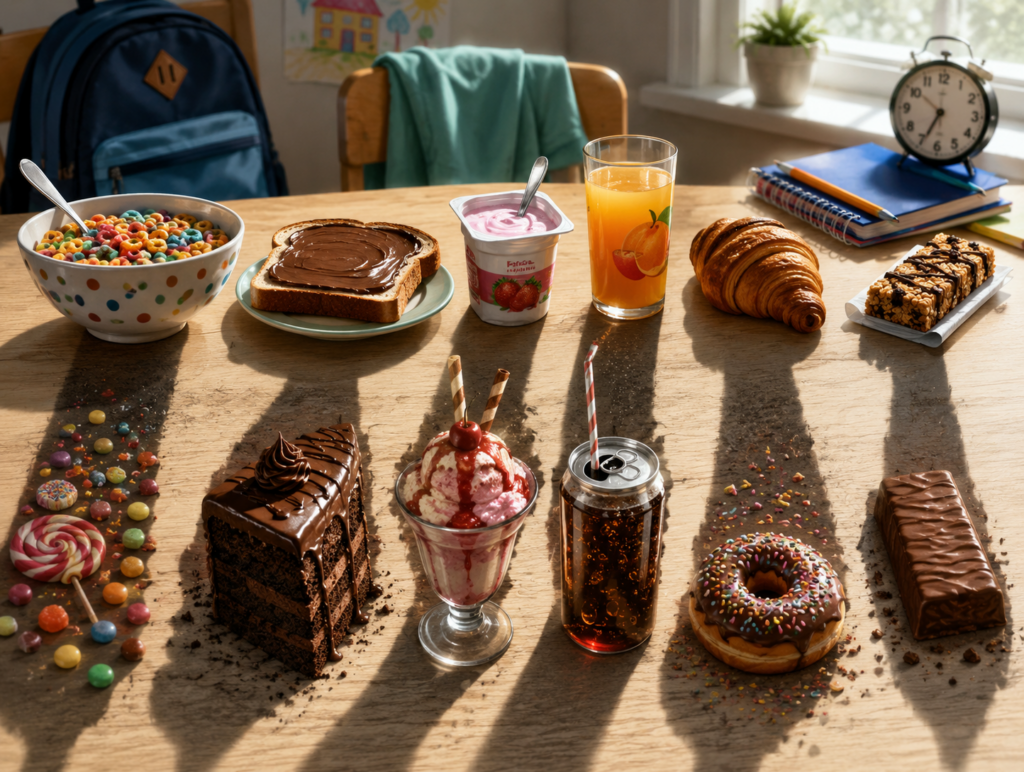
They start it with dessert disguised as breakfast.
A bowl of sweet cereal. White bread with chocolate spread. A sweetened yogurt. A pastry. A “fruit” drink. Maybe a packaged bar that looks healthy because it has oats on the label and a cartoon on the box.
To an adult in a hurry, this looks normal. It is convenient. It is available. It is marketed as breakfast. It has vitamins printed on the package. It may even have words like “energy,” “growth,” “whole grain,” or “natural” on the front.
But the child’s body does not read the marketing.
The body receives sugar, refined starch, flavouring, and a fast reward.
Then the child enters the classroom.
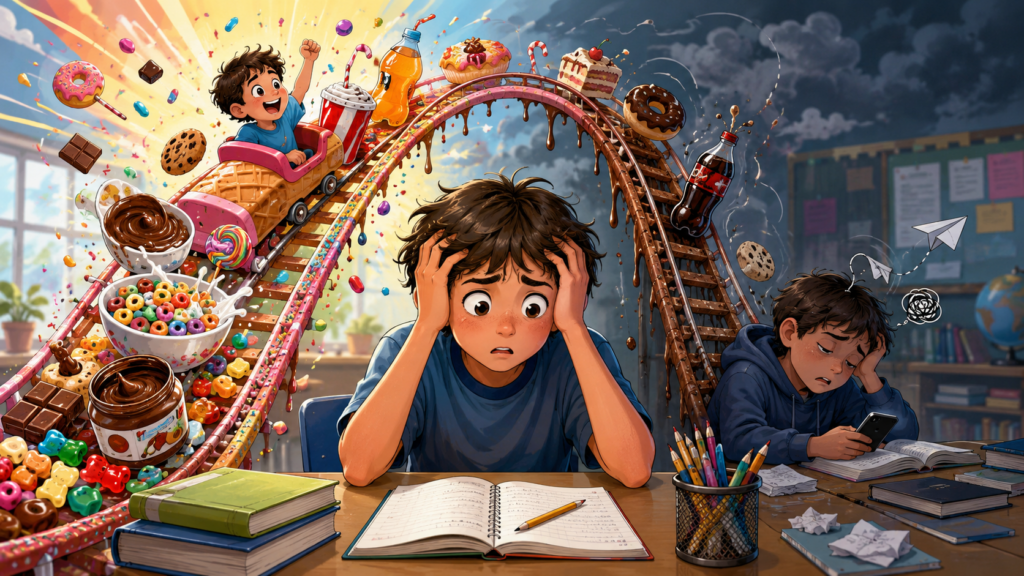
We ask them to sit, listen, wait, read, calculate, remember, write, cooperate, and control their impulses. But for many children, the school day begins after a metabolic and sensory rollercoaster has already started.
This does not mean every restless child has eaten too much sugar. Human behaviour is more complex than that. Sleep, stress, screens, family life, movement, classroom environment, emotional regulation, and neurodevelopment all matter.
But food matters too.
And we should stop pretending that it does not.
The Sugar Rollercoaster and the Classroom
The old claim that “sugar makes children hyperactive” is too simple.
Research does not support the idea that sugar alone has a direct, universal, immediate effect on every child’s behaviour.
But that does not make modern sugar consumption harmless. The problem is broader.
A child who regularly consumes sweet breakfasts, sweet snacks, sweet drinks, refined carbohydrates, and ultra-processed foods is not simply eating “a little sugar.” That child is growing up in a reward environment where sweetness becomes normal, water tastes boring, real food feels less exciting, and the body is asked to run on unstable fuel.
In the classroom, this can show up in many ways.
Some children are tired before the day has properly begun. Some are restless. Some constantly seek stimulation. Some struggle to stay with slow tasks. Some are hungry again quickly. Some become irritable. Some lose focus. Some seem to bounce between energy and collapse.
Again, sugar is not the only cause. But it can be part of the pattern.
Sometimes students are not only emotionally overstimulated.
They are metabolically overstimulated too.
Sweet Drinks: The Easiest Way to Overload a Child
If there is one place to begin, it is drinks.
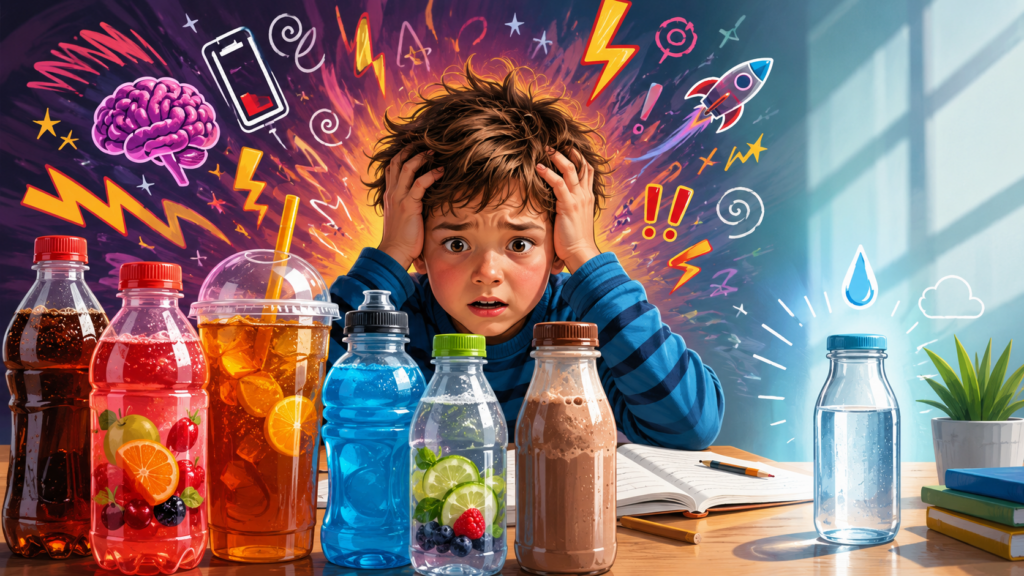
Sweet drinks are one of the easiest ways for children to consume large amounts of sugar without feeling that they have eaten anything.
Soft drinks, juices, iced teas, flavoured waters, sports drinks, chocolate milk, sweetened coffee drinks, and “fruit” drinks often enter the body quickly and quietly. They do not require chewing. They do not create the same fullness as real food. They are easy to sip all day.
This is how sweetness becomes background noise. A child who no longer drinks water has not simply developed a taste preference. They have developed a sweetness dependency.
Water begins to feel boring. Plain milk feels boring. Unsweetened tea feels boring. Real fruit feels less exciting than fruit-flavoured liquid.
And once every drink must be sweet, the child’s taste system has been trained. That training matters. Because the classroom is also asking the same child to do something that is not instantly sweet: to read a difficult paragraph, solve a problem, wait for a turn, listen carefully, practise handwriting, learn a new concept, or finish a task that does not immediately reward them.
The modern food environment teaches fast reward.
Learning often requires delayed reward.
That is the conflict.
Energy Drinks: When Sugar Gets a Stimulant Partner
Energy drinks deserve special attention.
They are not just “another soda.” They often combine caffeine, sugar or artificial sweeteners, acids, intense flavouring, performance marketing, gaming culture, sports imagery, and adolescent status. They are sold as energy, confidence, focus, power, rebellion, and identity in a can.
For children and teenagers, this is a dangerous message. A tired student does not need a stimulant habit. A stressed student does not need caffeine disguised as lifestyle. A distracted student does not need a drink that trains the nervous system to expect artificial energy on demand.
If sugar is a reward signal, energy drinks are reward plus stimulation – sold in a can.
And that combination should worry parents, teachers, and policymakers.
This is why several countries have already moved from advice to regulation. Lithuania, Latvia, Poland, Romania, Hungary, and Bulgaria have introduced bans on the sale of energy drinks to minors. England has committed to introducing a ban on high-caffeine energy drinks for children under 16 during this parliamentary term. Croatia has also seen proposals to ban the sale and serving of energy drinks to minors.
That tells us something important: this is no longer just a private family choice. It is becoming a public health question. Schools should not treat energy drinks as normal student beverages.
They should treat them as a warning sign.
Hidden Sugar and the Industrial Food Trick
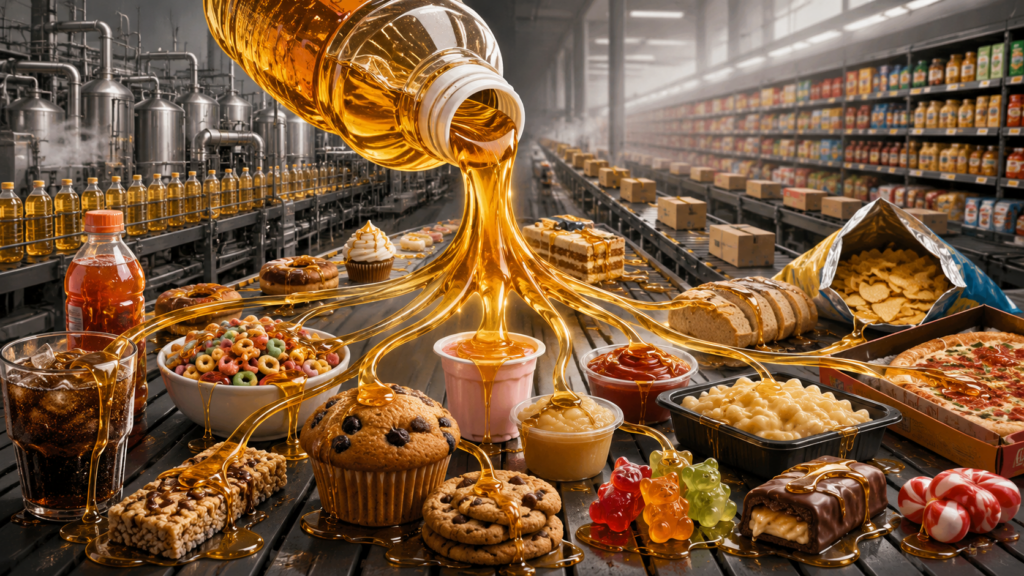
If there is one ingredient that deserves to be treated as a prime suspect in the industrialisation of everyday sweetness, it is high-fructose corn syrup.
Not because it is the only cause of obesity, poor focus, or metabolic problems.
It is not.
But because it became one of the perfect tools of modern processed food: cheap, liquid, easy to mix, easy to transport, useful in drinks, useful in processed foods, and extremely effective at making products taste better and sell more.
High-fructose corn syrup helped move sweetness from the dessert plate into the background of daily life.
It is not only in soft drinks. It can appear in cereals, baked goods, sauces, snacks, flavoured products, frozen foods, and many other processed items. That is the real problem. Sugar stopped being an occasional pleasure and became an invisible ingredient of the modern food system.
Food manufacturers understand something very well: if food is sweet enough, salty enough, or fatty enough, people come back for more.
Modern processed food is not designed only to feed.
It is designed to be repeated.
And children are the easiest customers to train.
This is why parents often feel they are fighting a battle they never agreed to enter. They are not only competing with a child’s preference. They are competing with laboratories, packaging, advertising, flavour engineering, supermarket placement, cartoon characters, vending machines, peer pressure, and habits built one snack at a time.
The child says, “I like it.”
The industry says, “Exactly.”
Why “Zero” Is Not the Perfect Escape
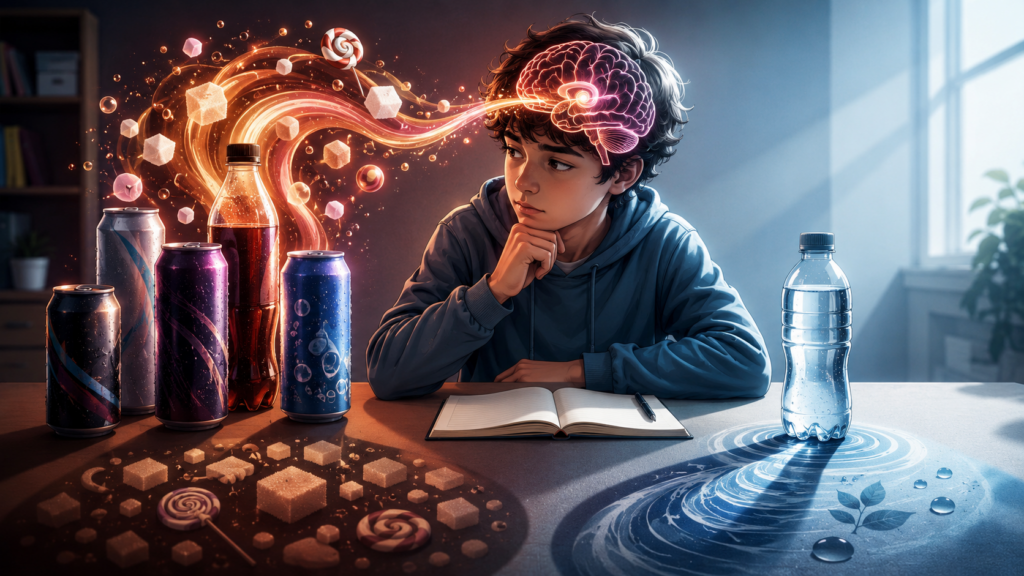
Many parents and teenagers think they have found the solution: zero sugar drinks.
No sugar. No calories. No problem.
But the deeper problem is not only sugar.
The deeper problem is the constant expectation that everything should taste sweet.
Artificially sweetened drinks may reduce sugar intake in the short term. But they can also keep the taste system trained around sweetness. They may remove the calories, but they do not necessarily remove the habit.
The goal is not to replace sweet sugar with sweet chemistry.
The goal is to reduce the expectation that every drink must be sweet.
Water should not feel like punishment.
It should feel normal.
That is a cultural shift, not just a nutritional one.
What Families Can Do at Home?
Families do not need to become extreme.
They need to become intentional.
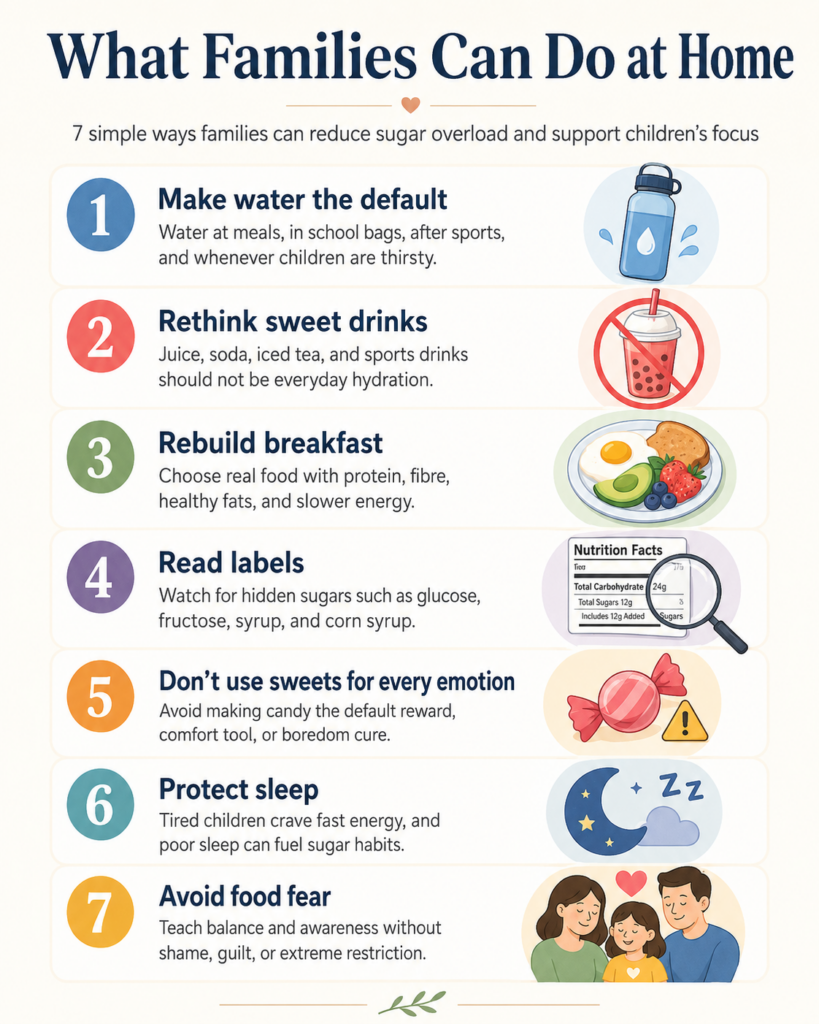
The first step is to make water the default drink. Not a punishment. Not a lecture. Just normal. Water at meals. Water in the school bag. Water after sports. Water when thirsty.
The second step is to stop treating sweet drinks as daily hydration. Juice, soda, iced tea, flavoured water, and sports drinks should not be the normal way a child drinks.
The third step is to rebuild breakfast. A focus-friendly breakfast should include real food: protein, fibre, healthy fats, and slower energy. Eggs, plain yogurt, nuts where appropriate, cheese, oats without added sugar, whole fruit, vegetables, beans, whole-grain bread, or leftovers from a real meal are all better foundations than dessert in a bowl.
The fourth step is to read labels. Sugar hides behind many names: glucose, fructose, dextrose, maltose, syrup, corn syrup, high-fructose corn syrup, fruit juice concentrate, cane sugar, invert sugar, and many others.
The fifth step is to stop using sweets as the default emotional tool. Candy for comfort, candy for silence, candy for reward, candy for celebration, candy for boredom — this creates a powerful association. The child learns that every emotional state deserves a sweet answer.
The sixth step is to protect sleep. A tired child craves fast energy. Poor sleep and sugary food often feed each other.
And the seventh step is not to turn food into fear.
Children should not be shamed for enjoying sweet things. Shame does not create health. Fear does not create wisdom. But normalising sugar all day, every day, does not create freedom either.
It creates dependency.
What Schools Can Do?
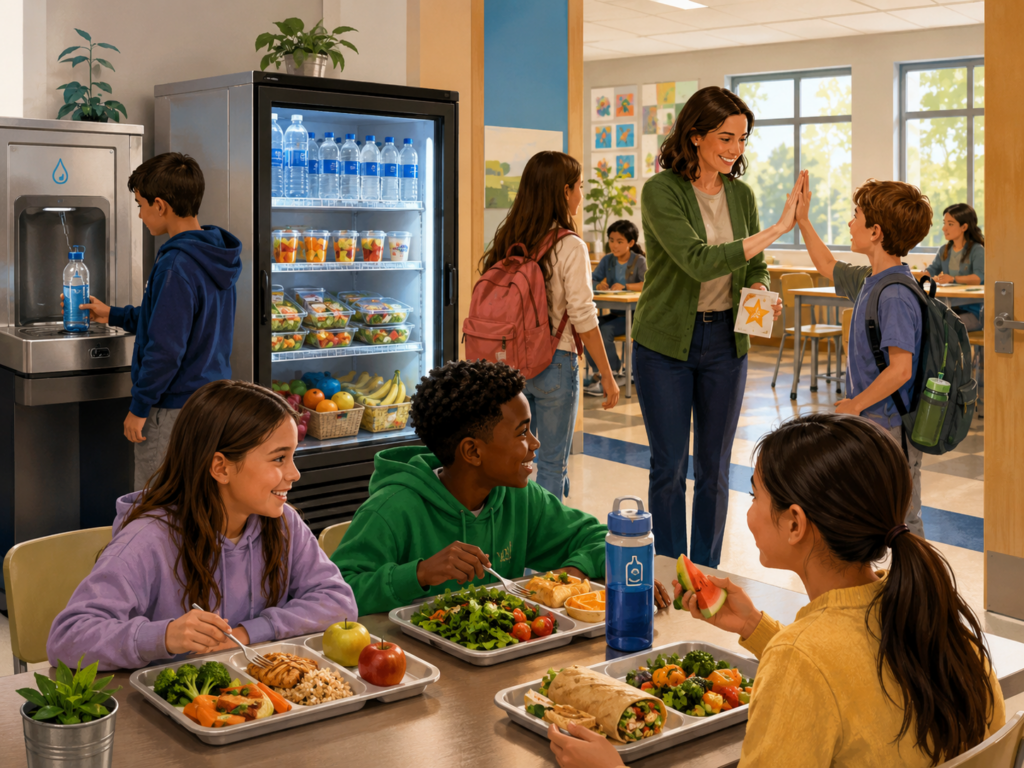
Schools have more power than they often realise.
They can stop selling or allowing energy drinks. They can review vending machines. They can reduce sweet drinks and ultra-processed snacks. They can make water easy, visible, and normal. They can rethink school celebrations so that every event is not built around candy, cake, and soda.
Schools that provide meals have an even greater responsibility. A school lunch should not quietly continue the same sugar pattern children already receive from the food industry. Breakfasts, snacks, and lunches should be built around real food, steady energy, protein, fibre, water, and simple meals – not sweet drinks, sweet yogurts, sweet cereals, desserts disguised as “healthy options,” and ultra-processed convenience foods.
Schools can also stop using sweets as classroom rewards.
This matters.
When a teacher gives candy for good behaviour, the hidden lesson is clear: sugar is the prize. Sugar means success. Sugar means approval. Sugar means celebration.
There are better rewards: responsibility, choice, movement, music, extra reading time, class games, creative activities, recognition, leadership roles, outdoor time, or simply sincere praise.
Schools can also teach food literacy.
Students should learn how to read labels, how marketing works, why drinks are designed to be sweet, why energy drinks are different from normal drinks, and how food affects mood, sleep, energy, and focus.
This should not be taught as body shame.
It should be taught as self-respect.
The message is not, “Eat this so you look better.”
The message is, “Understand what you consume, because your attention, energy, health, and future are worth protecting.”
What Teachers Can Do When Students Are Already Sugar-Overloadeed?
Sometimes the teacher has to deal with the situation as it is.
The birthday party has just ended. The children have had cake, juice, candy, and excitement. The school break included sweet drinks or vending-machine snacks. A few students may have arrived with energy drinks. The room is loud, bodies are restless, and asking everyone to “just calm down” does not work.
In that moment, the goal is not punishment.
The goal is regulation.
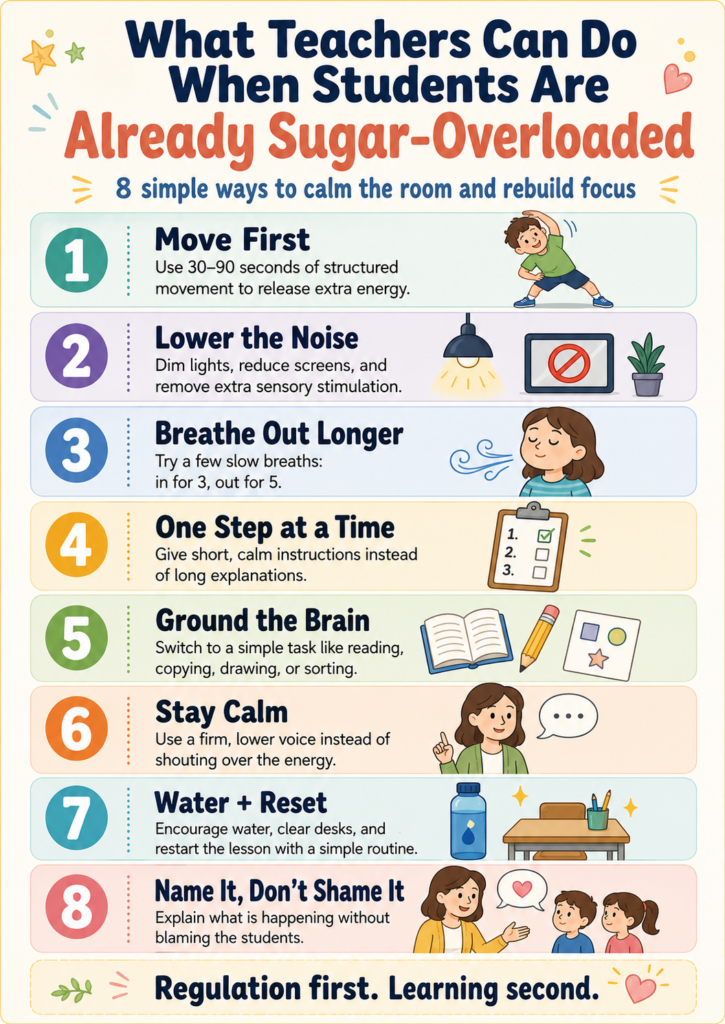
First, use movement before stillness. A class that is physically overloaded may need thirty to ninety seconds of structured movement: standing up, stretching, shaking out arms, walking silently around the room, or doing a short physical reset. The point is not to make the room wilder. The point is to discharge energy in a controlled way.
Second, lower the sensory load. Dim the lights if possible. Reduce screen use for a few minutes. Stop competing sounds. Clear the next instruction. A sugar-overloaded class does not need more stimulation.
Third, use breathing with a longer exhale. Keep it simple: inhale for three, exhale for five. Do it only a few times. Do not turn it into a performance. The longer exhale helps the body return toward calm.
Fourth, give one instruction at a time. Do not give a long lecture about behaviour when students are already dysregulated. Short, calm instructions work better: “Stand behind your chair.” “Hands on the desk.” “Eyes here.” “Open your notebook.” “Write the date.”
Fifth, switch to a grounding task. Reading silently, copying one sentence, drawing a simple diagram, sorting materials, writing three words, or doing a short reflection can help the brain move from stimulation back into structure.
Sixth, avoid shouting over the energy. Shouting may stop behaviour for a moment, but it also adds more intensity to an already overstimulated room. A calm, firm, lower voice often works better.
Seventh, use water and a reset routine. Encourage students to drink water, sit properly, clear their desk, and restart the lesson. The routine should feel normal, not like punishment.
Eighth, name the pattern without shame. You can say: “After a lot of sugar and excitement, it can be harder for the body to settle. That is why we are going to help the body calm down before we continue.”
This teaches students something valuable.
Their body has states.
Their attention can be disturbed.
And they can learn how to return to focus.
That is not only classroom management.
That is education.
10 Simple Ways Teachers Can Reduce Sugar-Driven Restlessness
Teachers cannot control everything students eat. But they can influence classroom culture.
1. Do not use candy as the default reward
If sugar is the prize, students learn that sweetness is the highest form of recognition. Use non-food rewards whenever possible.
2. Encourage water bottles
Make water normal in the classroom. A simple water routine is better than students relying on juice, soda, or energy drinks.
3. Notice patterns
Pay attention to what happens after birthdays, parties, vending-machine breaks, school events, or energy drink use. Patterns teach more than assumptions.
4. Talk about food as fuel for focus
Avoid body shame. Focus on attention, energy, mood, learning, and steady thinking.
5. Teach students to read sugar on labels
Many students are shocked when they see how much sugar is in drinks, cereals, sauces, and snacks.
6. Avoid moral labels
Do not say “good children eat good food” or “bad food makes you bad.” Food education should build awareness, not guilt.
7. Use movement breaks
If students come in restless after a high-sugar event, do not only demand stillness. A short movement reset can help the body return to regulation.
8. Coordinate with parents
Before class parties or regular snack routines, communicate clearly. The goal is not to ban joy. The goal is to avoid turning every gathering into a sugar event.
9. Create focus-snack norms
Where food is allowed, encourage snacks that support steadier energy: whole fruit, plain yogurt, cheese, boiled eggs, vegetables, nuts where safe, or simple whole foods.
10. Link nutrition to attention
Ask students: What helps your brain stay steady? What makes you tired? What makes you restless? What helps you focus?
When children understand the connection, they become participants rather than targets of correction.
Sugar Is More Like Fireworks Than Food

Added sugar is not an illegal drug, and children should not be made afraid of food.
But sugar is a powerful reward signal.
That means it should not be the background fuel of childhood. It should not be the default breakfast, the default drink, the default snack, the default comfort tool, and the default classroom reward.
Sugar should be treated more like fireworks than food: exciting, powerful, and best kept for rare occasions.
Not for every morning.
Not for every break.
Not in every bottle.
Not as the normal taste of childhood.
Children do not need a joyless life.
They need a life in which joy is not constantly manufactured by sugar, screens, caffeine, and ultra-processed rewards.
They need real food, real movement, real sleep, real connection, and real focus.
Because when we protect what enters the child’s body, we also protect what happens in the child’s mind.
And in a world designed to overstimulate them, that protection is no longer optional.
It is part of education.
Or at least, it should be.
Stay curious.