Playing It Safe Is Now the Riskiest Strategy
In just a few years we’ve gone from “classic” artificial intelligence and machine learning, through generative AI and copilots, to what we now call agentic AI – systems that don’t just answer questions, but can plan, choose tools and take actions toward goals with minimal human prompting.
The next wave is already visible on the horizon: embodied AI – intelligence that doesn’t live only in the cloud, but is embedded in robots and physical systems.
Taken together, this means we are likely entering a decade in which:
- billions of digital agents will be working silently in the background, and
- millions of physical robots will work side-by-side with humans.
We are not at the technological singularity yet, but we are close enough that pretending it won’t happen is probably the biggest risk a leader can take.
Change Is No Longer Episodic – It’s Continuous
The latest global CEO study from IBM Institute for Business Value and Oxford Economics confirms what most leaders already feel:
change is no longer episodic – it’s continuous.
Geopolitics, supply chains, regulation, capital markets, customer expectations and technology are all shifting at the same time. In that environment, the old pattern…
big transformation → stabilization → next big transformation
…simply doesn’t work anymore.
CEOs in the study increasingly talk about a new reality in which:
“Predictability is the new currency.”
But predictability no longer means “we know exactly what will happen in five years.” It means having a culture and operating system that allow the organization to:
- sense what is changing,
- run small experiments,
- learn quickly and share those learnings,
- and adapt without waiting for the next grand program.
That is exactly the promise of Continuous Innovation Culture (CIC):
- flat structures and distributed decision-making,
- modular design and rapid iteration,
- self-managed, cross-functional teams (organized in swarms and tribes),
- parallel work and constant prototyping.
In a CIC environment, predictability simply means:
“We don’t know precisely what’s coming, but we know we will respond fast and intelligently when it does.”
What We Can Learn from the Top ~14% of CEOs
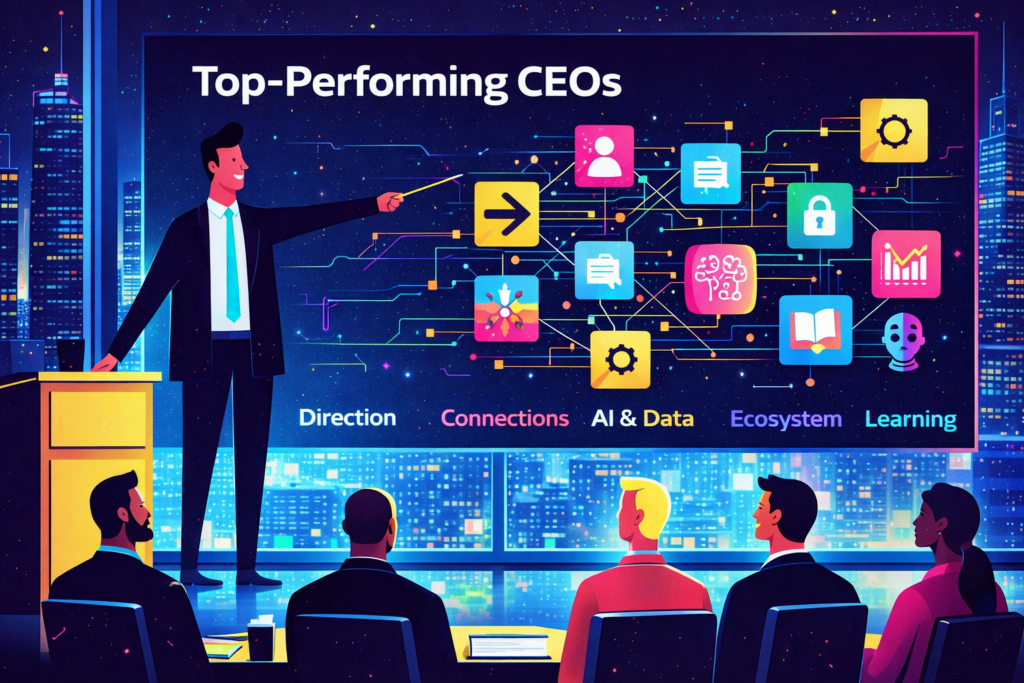
The IBM/Oxford study highlights a small but very important segment – roughly one seventh of CEOs whose companies significantly outperform the rest in both growth and profitability. The report calls them “leading” or “luminary” CEOs.
What do they do differently?
In short, they:
- hold a clear and courageous direction and are not paralysed by fear of mistakes,
- connect business functions end-to-end instead of feeding silos,
- treat AI and data as strategic assets, not IT add-ons,
- actively cultivate ecosystems of partners, not only internal hierarchies,
- invest enough personal time to truly understand AI, rather than outsourcing understanding of the future.
This is almost a textbook description of leaders who already live the principles of Continuous Innovation Culture and the infinite-game mindset: focusing not on winning a single quarter, but on building an organization that can keep evolving faster than its environment.
AI-Fueled Creative Destruction
Modern AI agents can already scan an entire organization – processes, data, workflows, performance – and surface non-obvious patterns.
Crucially, they can help leaders decide:
- what to keep as it is,
- what to transform,
- what to shut down because it no longer creates value.
This is creative destruction with an instrument panel.
But it only works if the organization has:
- clean, connected data,
- a clear strategic frame,
- and enough psychological safety to say:
“This made sense five years ago. It doesn’t anymore. Let’s sunset it and free resources.”
Here CIC fits perfectly: modular processes, small swarm teams and clear experimental boundaries let you demolish and rebuild parts of the system without collapsing the whole building.
Ignore FOMO, Lean Into ROI – Build a Repeatable Innovation Engine
Over the last three years, CEOs say only about a quarter of AI initiatives delivered the expected return on investment, and barely one in six scaled across the enterprise. Today, almost two thirds say they prioritize AI use cases based on ROI rather than hype.
That shift is exactly what Continuous Innovation Culture is designed for.
Instead of chasing every shiny AI announcement, CIC organizations:
- build a portfolio of small, fast experiments,
- define clear success metrics for each initiative (not just cost savings, but also learning speed, customer impact, risk reduction and new revenue potential),
- and keep a regular decision rhythm: continue – pivot – stop, based on evidence, not ego.
The goal is not to have “an AI project.”
The goal is to build a repeatable innovation engine that keeps generating ROI.
Borrow the Talent You Can’t Buy – Build, Buy, Bot, Borrow
In the age of agentic and embodied AI, the talent market is under maximum pressure. New roles appear faster than traditional HR can define them, let alone fill them.
A simple but powerful strategy is emerging:
build, buy, bot, borrow:
- Build – reskill and upskill the people you already have into AI-relevant roles.
- Buy – hire where skills are truly core to your long-term differentiation.
- Bot – use AI assistants and agents to take over repetitive cognitive work and close capability gaps.
- Borrow – rely on partners and ecosystems when it doesn’t make sense to build everything in-house.
In practice, this means the boundaries of the organization stretch. Teams increasingly work across formal company borders, and sometimes even with competitors on shared standards, platforms and innovation initiatives.
Winners are no longer the ones with the most employees on their payroll, but those who best orchestrate their ecosystem.
So What Now?
A CIC Playbook for the Age of Agentic and Embodied AI
If we combine the accelerating AI curve (especially agentic and embodied systems), the realistic possibility of AGI and the insights from the IBM/Oxford CEO research, we can sketch a practical playbook for leaders who want to be in that “top 14%”.
This is how a Continuous Innovation Culture playbook for the next 5–10 years looks:
- Explicitly adopt an infinite-game mindset
Don’t treat AI as a project with an end date. See it as part of a multi-decade shift in how humans and machines create value together. The aim is to build an organization that survives multiple technology waves, not just this one. - Make courage your core – but structure the risk
Playing it safe really is the riskiest strategy now. Courage doesn’t mean chaos; it means designing flat, fast decision structures, clear goals and “innovation liquidity” – budgets that can move quickly from operations to experiments and back. - Build an AI-centric insight engine on a strong data fabric
Your AI agents need a circulatory system: connected, high-quality, well-governed data across the business. This is the foundation for better forecasts, simulations and decisions. - Organize around swarms, not departments
Replace large functional silos with small, self-managed, cross-functional CIC teams that test ideas, prototypes and business models in short iterations. - Intentionally design the human + AI + partner workforce
Map explicitly: what do humans do, what do AI agents do, what do robots do, what do partners do? Where must humans stay in the loop, and where is it enough that they supervise? This cannot be left to chance. - Treat partners as an extension of your teams
Set up governance, contracts and culture so that partners can genuinely become part of the “wider team”, instead of a classic vendor relationship. That includes universities, startups, research labs – and sometimes even competitors. - Invest in your own learning habit as a leader
Reserve time every day – at least an hour – for direct hands-on work with AI tools, reading, watching demos and talking to people at the edge of this technology. You can’t lead a game you don’t personally play.
Conclusion: Playing It Safe Is Now the Riskiest Strategy
Today’s CEO lives in a paradox: to stay competitive, they must take more risk than their rivals, but they cannot afford too many big, expensive mistakes.
The way out is not to retreat into the comfort zone.
The way out is to build a Continuous Innovation Culture in which:
- risk is distributed across many small, well-designed experiments,
- learning is fast and visible,
- AI agents and data provide better insight,
- ecosystems multiply your levers of time, talent, capital, creativity, media and velocity.
In such a culture you don’t need to be a prophet.
You just need to be curious, courageous and disciplined – and willing to learn from the top ~14% instead of hiding in the comfortable majority.
Stay curious.
Further reading
For readers who want to dive deeper into the data and concepts behind this article:
- Full IBM 2025 CEO Study – IBM Institute for Business Value / Oxford Economics
- Disrupt or Be Disrupted: Continuous Innovation Shift
- Leverages of Wealth and Progress
- AfterAgile.net