From Post-it Theater to a Real Engine of Continuous Innovation
Most organizations say they “do Design Thinking” because they ran a workshop once and filled a wall with sticky notes. Then they go back to the same old roadmaps, the same old politics, and the same old guessing about what customers want. The result? A lot of colorful photos for LinkedIn – and very little actual change.
Design Thinking was never meant to be decoration. Done well, it’s a disciplined, repeatable way of seeing the world through your customer’s eyes and designing smarter bets under uncertainty. In this article, we’ll look past the buzzword and explore what Design Thinking really is, why so many companies get stuck at the surface level, and how it can become the human engine of a true Continuous Innovation Culture.
If you walk through most “innovative” offices today, you’ll notice the same scene: Glass walls. Sticky notes. Colorful markers. Maybe a Design Sprint poster fading on the wall.
And yet…
Customers still complain.
Teams still ship the wrong things.
Leaders still feel like they’re guessing.
So what’s missing?
Very often, it’s not Design Thinking as a process that’s missing. It’s Design Thinking as a habit and as a culture.
In a Continuous Innovation Culture, Design Thinking isn’t a workshop. It’s the way people choose problems, frame ideas, and make decisions – every week, not just at off-sites.
Let’s unpack what that actually means in practice.
Beyond the Buzzword: What Design Thinking Really Is
At its core, Design Thinking is a human-centered, experimental way of solving problems under uncertainty.
Instead of starting with:
“What can we build with this technology?”
it starts with:
“Whose problem are we solving, and what’s truly going on in their world?”
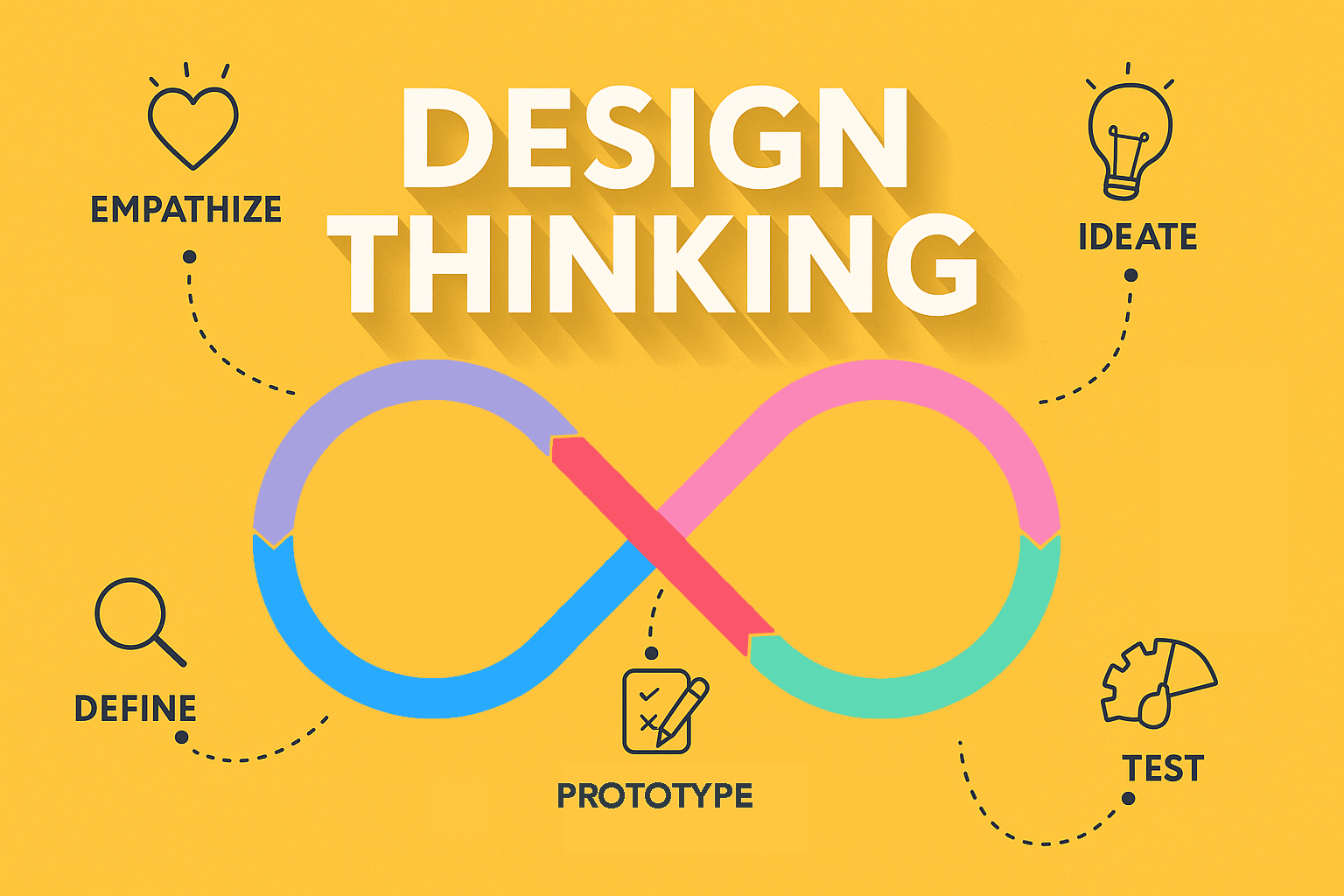
Most frameworks describe Design Thinking as a non-linear, iterative process that moves through five classic modes:
Empathize, Define, Ideate, Prototype, Test.
But in real life, those are less like five boxes in a diagram and more like five muscles you keep using:
- Empathize – Get out of the building. Observe, listen, and feel the friction in real people’s lives.
- Define – Turn all that messy reality into a sharp problem statement: “How might we…?”
- Ideate – Generate many possible answers before you fall in love with one.
- Prototype – Make ideas tangible, fast and cheap. Cardboard, sketches, Figma, Lego, role-play.. it all counts.
- Test – Put it in front of real users and let reality punch your idea in the face (kindly).
The power of Design Thinking is not that you have five neat steps.
The power is that you stop building from assumptions and start building from insight.
What Design Thinking Is Not
Before we go deeper, a few myths to clear up.
1. It’s not a Post-it party.
If your “innovation initiative” ends with photos of colorful walls and no decisions, you’ve done theater, not Design Thinking.
2. It’s not only for designers.
Some of the best Design Thinkers I’ve met had titles like “CFO”, “HR lead” or “factory supervisor”. The job title is irrelevant; the mindset is everything.
3. It’s not a one-off project.
A two-day workshop can spark energy, but if nothing in your weekly routines changes afterwards, your culture is still built around old logic:
Plan – Approve – Build – Pray.
Design Thinking becomes powerful when it is baked into how you prioritize, fund, and measure work.
Why Design Thinking Matters More Than Ever
We’re living in a world where:
- AI can generate 100 versions of your idea in minutes.
- Technology cycles shrink from years to months.
- Customer expectations move faster than your budgeting process.
In that environment, the most dangerous sentence in a leadership meeting is:
“I know what our customers want.”
Design Thinking replaces that certainty with curiosity.
Instead of betting millions on a few “big ideas”, teams run many small experiments:
- They talk to a handful of users before writing requirements.
- They prototype three versions of a service before committing to an IT project.
- They test a new process in one team before rolling it out to 3,000 employees.
It’s cheaper. It’s faster. And – most importantly – it’s less arrogant.
As Tim Brown from IDEO famously put it, Design Thinking brings together human needs, technological possibilities and business viability. In Continuous Innovation Culture, that’s not a slogan. It’s a filter for every decision.
Design Thinking Inside a Continuous Innovation Culture
So how does Design Thinking actually show up when a company is serious about Continuous Innovation?
Imagine a regular week:
- Monday starts with a short review of customer insights, not just KPI dashboards. Someone brings a frustrated email from a client; another shares a story from a field visit.
- Mid-week, a cross-functional team blocks 90 minutes to reframe a problem:
“Our app has low engagement” becomes
“Young parents open our app only when they’re already stressed. How might we support them before the stress peak?” - By Friday, they have three prototypes: a notification concept, a radically simplified flow, and a small service tweak. All ugly. All testable. All in front of 5–10 users before the week ends.
No huge budgets. No six-month “analysis phase”.
Just a rhythm: See – Reframe – Try – Learn – Adjust.
Design Thinking becomes the front end of innovation.
Lean methods then help you remove waste and optimize; Agile practices help you deliver in increments. That full pipeline – from insight to scaled solution – is exactly what I explore in depth in my upcoming book Disrupt or Be Disrupted: Continuous Innovation Culture Shift, where Design Thinking, Lean and Agile sit side-by-side as parts of one system, not competing religions.
The Double Diamond (and Why It Matters to Leaders)
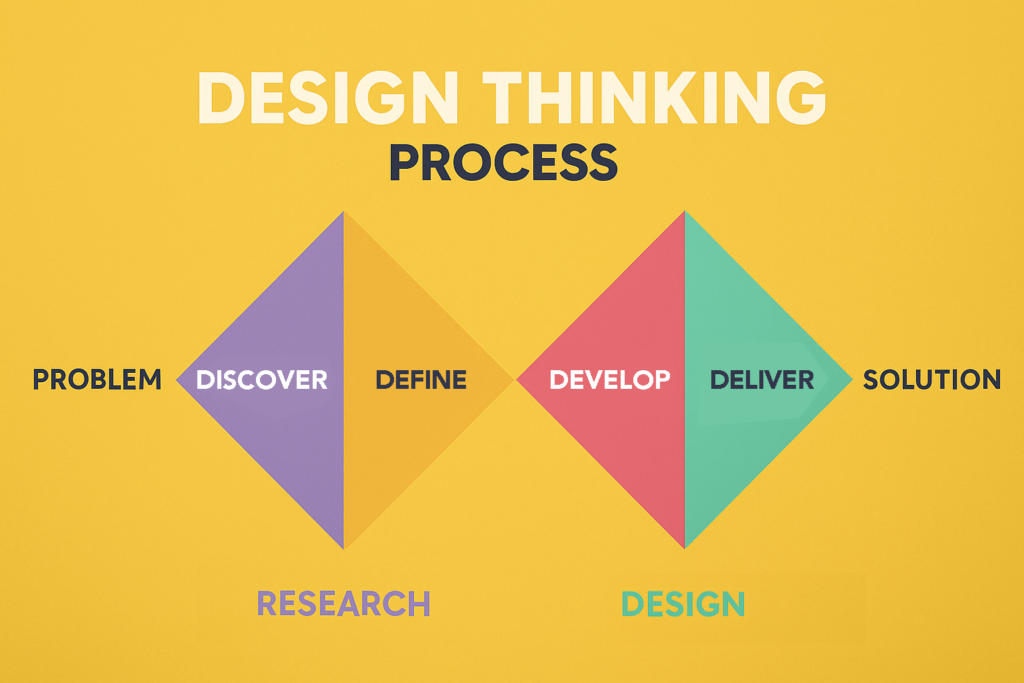
One helpful way to visualize Design Thinking is the Double Diamond model:
First you diverge and converge on the problem; then you diverge and converge on the solution.
In practice, this looks like:
- Discover – Open up. Collect stories, data, and observations. Be uncomfortable. Real life is messy.
- Define – Narrow down. Decide what problem is worth solving. Say “no” more than “yes”.
- Develop – Open up again. Explore many possible solutions.
- Deliver – Narrow down again. Choose, commit, and launch.
The reason leaders should care is simple:
Most organizations are excellent at converging and terrible at diverging.
They jump straight from a vague complaint (“Our portal is bad”) to a solution (“We need a new portal”) and then spend months arguing about features.
Design Thinking forces a different discipline:
- Diverge on understanding before you converge on decisions.
- Diverge on options before you converge on roadmaps.
It doesn’t slow you down. It prevents you from running fast in the wrong direction.
Want to See Divergent Thinking in Action?
If you’d like a powerful visual reminder of why divergence matters so much, watch this short, classic talk by Sir Ken Robinson.
It’s officially about education, but it’s really about how systems train us to look for one right answer instead of exploring many possibilities – exactly the muscle we need in the left side of the Double Diamond.
Sir Ken Robinson – Divergent Thinking (TED)
(one of the most-watched talks on creativity and education)
How Design Thinking Feels on the Ground
When Design Thinking becomes part of your culture, people behave differently:
- Product owners regularly say “I don’t know—let’s ask three customers this week.”
- Engineers are invited to user interviews, not only to sprint planning.
- HR designs employee journeys the same way UX teams design user journeys.
- Finance doesn’t just ask “What’s the ROI?” but also “What assumptions are we still testing?”
And maybe the biggest shift:
Failure stops being a verdict and becomes a data point.
A prototype that doesn’t work is not a reason for blame; it’s a gift. It tells you early, cheaply and clearly that this path isn’t worth scaling.
Five Small Ways to Start Tomorrow
You don’t need a big transformation program to start using Design Thinking.
You can begin with small, almost invisible moves:
- Add one real person to every slide.
Instead of “Segment A”, say “Nina, 36, single mother, always on night shift”. Make it human, not abstract. - Replace “solution statements” with “How might we…” questions.
“We need a new app” becomes
“How might we reduce the 30 minutes our drivers spend on paperwork every day?” - Prototype on paper first.
Before asking IT for estimates, sketch three options on paper and put them in front of users. See what they understand, where they get stuck, what they ignore. - Run a weekly “Customer Reality Check”.
30 minutes. One story from the field. One data point. One decision you’ll revisit because of what you heard. - Celebrate learning, not only launches.
In your team meetings, ask:
“What did we learn about our users this week?”
Put that question before “What did we deliver?”
None of this needs permission. It just needs intention.
From Method to Mindset (and Where to Go Deeper)
If you only remember one thing about Design Thinking, let it be this:
It’s less about being creative and more about being honest.
Honest about what you don’t know.
Honest about how often you guess.
Honest about the gap between the PowerPoint version of your customer and the real human on the other side of your product, service or policy.
Design Thinking gives you a structured way to close that gap.
In a world of AI, automation and endless “digital transformation” slides, the organizations that will truly disrupt (and not just be disrupted) are the ones that stay radically close to human reality—and build everything else from there.
If you want to explore how Design Thinking connects with Lean, Agile, and a broader Continuous Innovation Culture, you’ll find much more in my upcoming book:
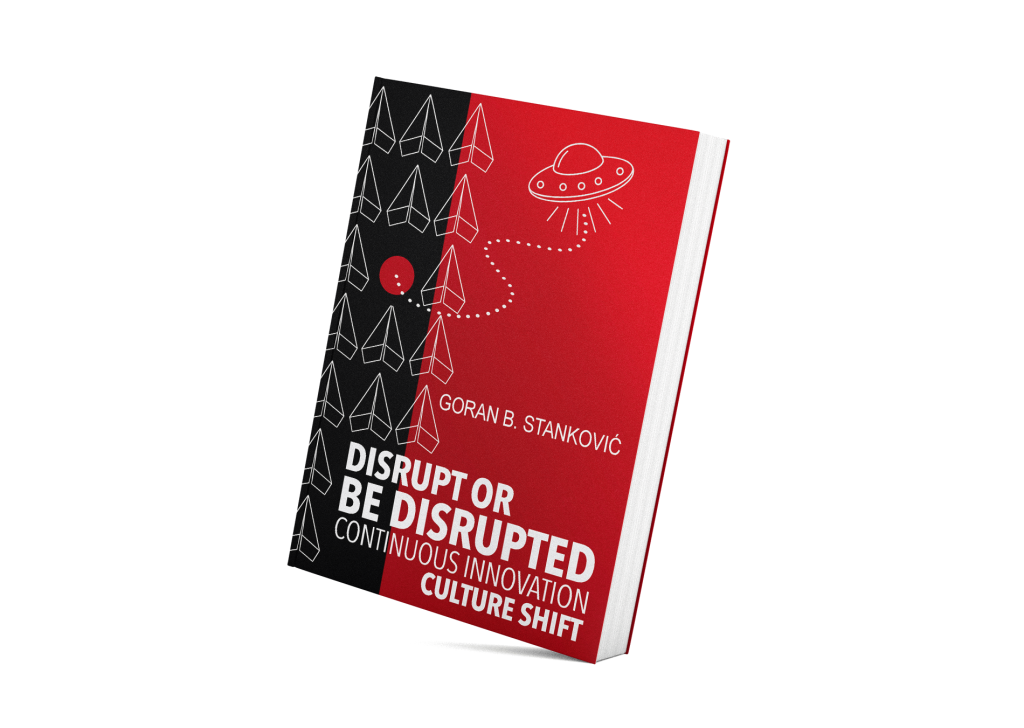
Disrupt or Be Disrupted: Continuous Innovation Culture Shift. There, I go beyond tools and workshops and focus on what really matters: how you design structures, incentives, and everyday routines so that innovation stops being an event – and becomes the way your organization breathes.
For more on my book, visit 150Pages.com/Disrupt-or-Be-Disrupted. For more on Design Thinking itself, check out the Interaction Design Foundation.
Until then, you don’t need a certificate to start.
You just need to pick one team, one problem, and one customer…
and design your way forward.
Stay curious.