In uncertain markets, adaptability beats planning every time.
Agile isn’t a shortcut – it’s a shift in how we build, decide, and learn.
It’s not about moving faster – it’s about learning smarter. And the faster you learn, the stronger you become.
I often get asked what Agile really is. A philosophy? A set of tools? A project management method that just replaced the last one? Or is it simply another business fad wrapped in sticky notes and buzzwords?
The confusion is understandable. Agile has become one of those words that’s been stretched, misused, and diluted until it means everything and nothing at once. But underneath all the noise, there’s a simple truth: Agile isn’t a method. It’s a mindset, a way of working that fits the pace and uncertainty of today’s world better than any rigid five-year plan.
A Quick History
Agile didn’t emerge from boardrooms or corporate strategy off-sites. It was born in 2001 on a ski trip in Snowbird, Utah. Seventeen software developers gathered and signed what became known as the Agile Manifesto – a rebellion against bloated project plans, endless documentation, and bureaucratic bottlenecks.
Their principles were disarmingly simple:
- Individuals and interactions over processes and tools
- Working software over comprehensive documentation
- Customer collaboration over contract negotiation
- Responding to change over following a plan
But while Agile became the modern symbol for adaptive work, it wasn’t the origin of these ideas. The roots run deeper. Lean, the philosophy that emerged decades earlier from Toyota’s manufacturing model, laid the groundwork. Lean focused on minimizing waste, empowering teams, and continuously improving flow and quality. Agile borrowed heavily from this thinking, but it took things further by applying it to creative, fast-changing knowledge work.
Later came Lean Startup, Eric Ries’ movement that combined Lean principles with Agile execution. It gave us MVPs (Minimum Viable Products), pivoting, and the idea that validated learning was more important than perfect planning. We’ll talk more about Lean Startup, Business Modeling, and Design Thinking in a future post.
Agile in Practice: From Scrum to Spotify
Agile today isn’t one-size-fits-all. It splintered into multiple frameworks, each offering its own flavor.
- Scrum brings structure: sprints, stand-ups, backlogs, retrospectives.
- Kanban emphasizes flow, transparency, and limiting work in progress.
- Extreme Programming (XP) focuses on engineering excellence – pair programming, test-first development, rapid feedback.
- Lean Startup brings agility to entire business models.
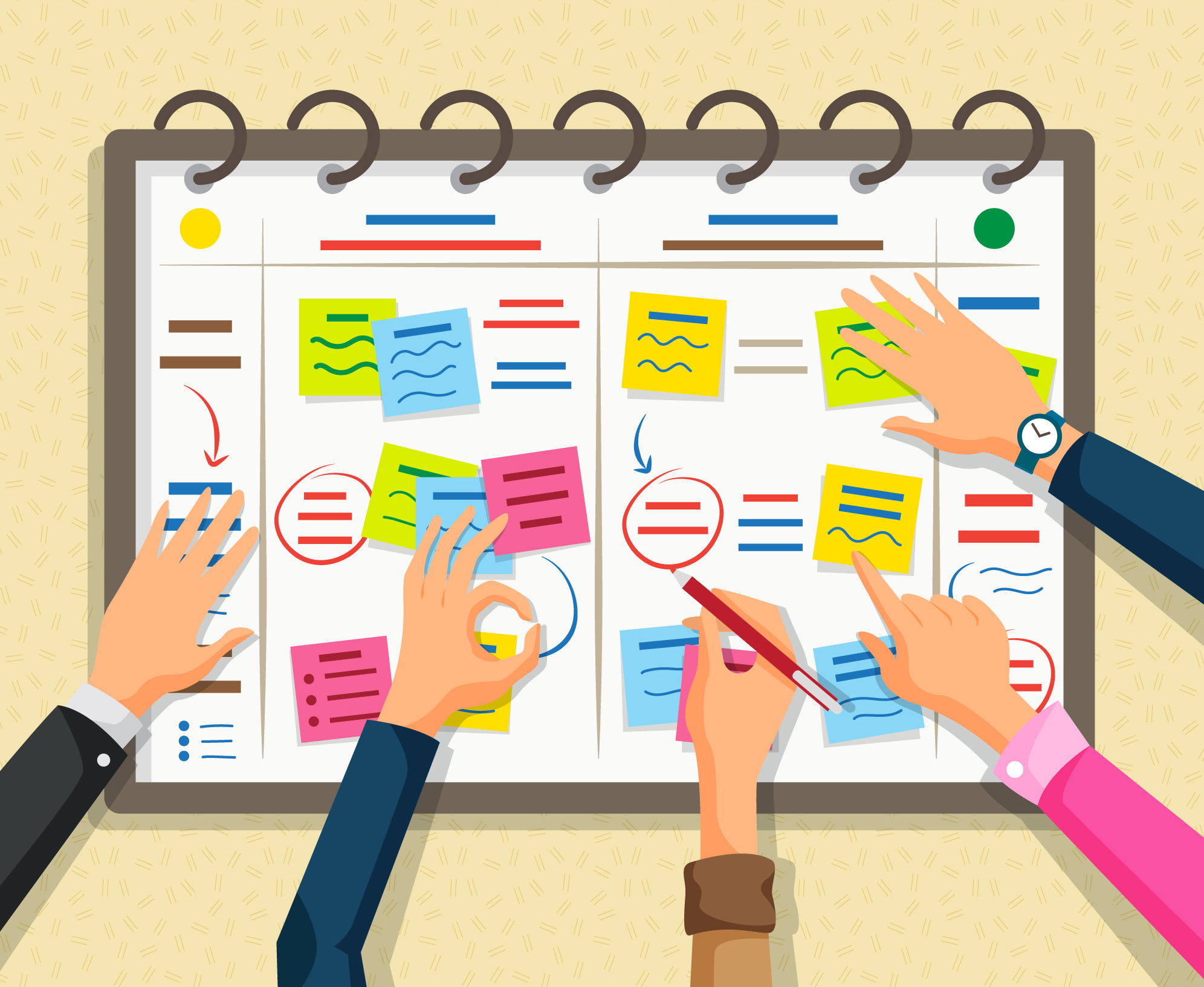
But frameworks are only half the story. Agility becomes real when it’s lived, not when it’s written on sticky notes.
Take Spotify. They created the now-famous “squad-tribe-chapter” structure – cross-functional, autonomous teams aligned around missions. They didn’t just adopt Agile; they evolved it.
Or look at Netflix. Agility isn’t about process – it’s cultural. Their mantra: “freedom and responsibility,” constant experimentation, empowered decision-making. No stand-ups needed.
Not Just for Tech: Starbucks, McDonald’s, and Everyday Agility

You don’t need to be a tech company to be agile.
Starbucks used agile, cross-functional teams to redesign their app – rolling out mobile ordering features through iterative testing and real-time customer feedback. It wasn’t about perfect planning; it was about learning quickly and adapting on the go.
McDonald’s applied agile principles when rolling out digital kiosks and revamping their kitchen workflows: testing in pilot markets, learning fast, and scaling only when confident. This is exactly the kind of mindset I explore in my upcoming book Leverages of Wealth and Progress, where I dive deep into the concept of a Culture of Experimentation – an essential part of creativity as leverage, and a non-negotiable element in any serious culture of continuous innovation.
Culture of Experimentation
Whether it’s A/B testing new features or running countless user feedback loops, companies like Facebook and Netflix live by the mantra of try it, test it, tweak it. In fact, at any given moment, there are reportedly around 10,000 different versions of Facebook running simultaneously as they constantly innovate and test. This “move fast and break things” attitude, famously embraced by both Facebook and Netflix, shows how speed and a willingness to experiment can turn a good idea into a blockbuster feature.
But one of the most underrated examples of relentless, behind-the-scenes experimentation comes from a company we all know, and most of us use without thinking twice: McDonald’s Self-Order Terminals (SOTs). You know, those touchscreen kiosks that kids treat like arcade games? They’re designed to be sleek, intuitive, and almost hypnotically easy to use. But beneath that friendly interface is a masterclass in psychological persuasion and agile experimentation.
McDonald’s is constantly A/B testing every detail: menu layouts, color schemes, pricing strategies, and even the precise moment it nudges you to add extra fries or a dessert. No one outside the company really knows how many different versions are running at any given time, but insiders suggest it’s a lot. Everything is under scrutiny:
- Which meal size looks like the best deal?
- Where should high-margin items be placed?
- What’s the perfect upsell prompt for a sauce or dessert?
- Even the wording of a single button can shift sales numbers.
The result? Over 15% increase in sales.
Start Small, Think Big
Agility isn’t about being fast. It’s about learning quickly and cheaply—then scaling what works.
You don’t need a team of consultants or a complete organizational overhaul to be more agile. Start small:
- Run one weekly retrospective.
- Test a new offer with five real customers before a big launch.
- Give a team decision-making power for one internal process.
Agility grows through action, not theory. And once you start, the compounding effect is remarkable – faster learning, smarter decisions, and a business that evolves with its environment instead of reacting to it too late.
If this way of thinking about agility resonates with you, you’ll find more real-world examples in my book Leverages of Wealth and Progress. And if you’d like to go deeper into agile methods and post-agile organizations that use continuous innovation to protect and strengthen their position in the market, look out for my upcoming book Disrupt or Be Disrupted: Continuous Innovation Culture Shift.
Stay curious.
Images by Ovidiu Tepes from Pixabay and Whiye Lamb Design