Understanding the hidden DNA of your company’s culture: Why Some Companies Soar and Others Sink
Most transformation projects fail because they only change the tools – not the mindset. Whether you know it or not, your organization is shaped by deep, often invisible assumptions about power, purpose, and people. Laloux gave us the map. Now it’s time to explore it.
We’ve spent the last two decades trying to make our organizations more agile. Which, in theory, means more adaptable, collaborative, and human. In practice, it often meant stand-up meetings at 9:00 and sticky notes in pastel colors. Agile was a fantastic start – but it was never meant to be the destination. It’s a method. A mindset. A toolbox. But what kind of culture is all that agility supposed to support?
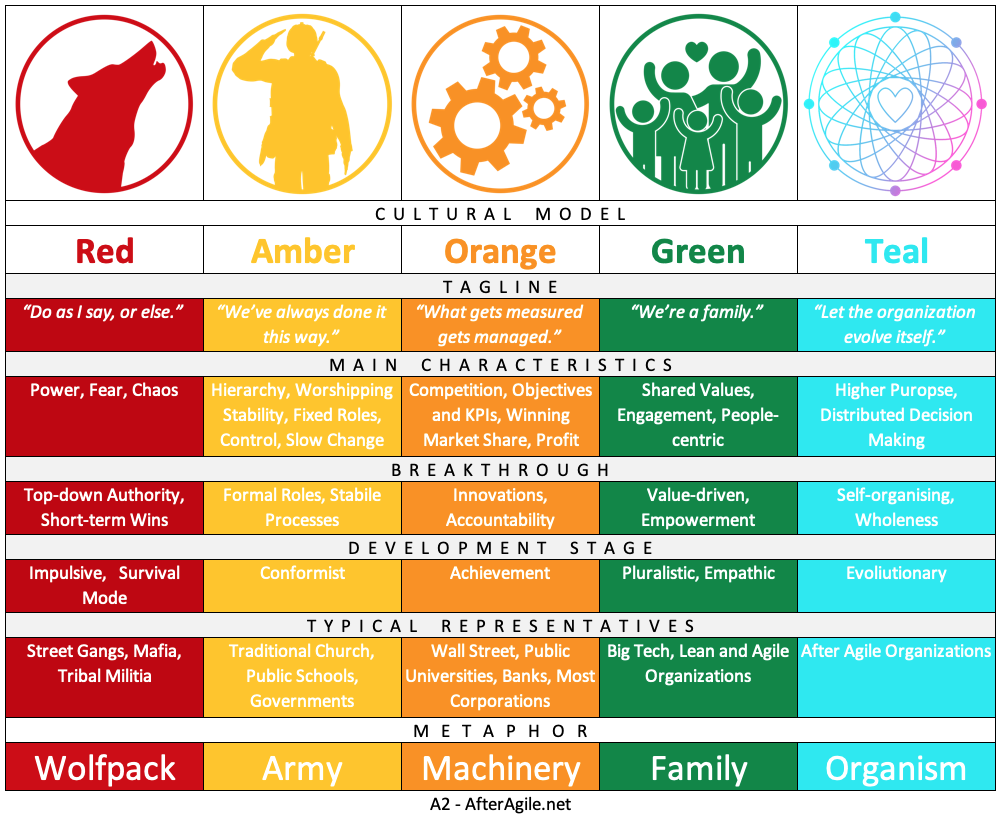
Laloux Culture Models
That’s the question Frederic Laloux dared to ask. In his groundbreaking book Reinventing Organizations, he mapped out not methods, but evolutionary stages of organizational culture, from tribal warlords to purpose-driven ecosystems. If Agile was about how we work, Laloux was asking why we work this way at all.
Let’s take a walk through the cultural zoo he describes. You may recognize some familiar beasts.
🔴 Red: Survival of the Fiercest
Culture model: Impulsive, power-based, reactive
Tagline: “Do as I say, or else.”
Examples: Street gangs, Mafia, tribal warlords
Red cultures are driven by dominance and short-term wins. They’re fast, brutal, and efficient when it comes to survival – but not exactly optimized for innovation. Or birthdays.
Occasionally, you’ll spot Red cultures hiding behind a polished corporate facade. They usually have a CEO with a nickname like “The Hammer.”
🟠 Amber: Order and Obedience
Culture model: Hierarchical, rule-based, rigid
Tagline: “We’ve always done it this way.”
Examples: The Church, traditional military, public institutions
Amber cultures worship stability. Roles are fixed, change is slow, and questioning the system is… frowned upon. There’s a handbook for everything – and a form to request the handbook.
These organizations can last for centuries. But don’t expect a hackathon anytime soon.
🟡 Orange: Success and Strategy
Culture model: Competitive, KPI-driven, achievement-focused
Tagline: “What gets measured gets managed.”
Examples: Most corporations, Wall Street, Big Tech (until recently)
Welcome to the corporate jungle. Orange cultures are all about winning – market share, efficiency, awards. They gave us the stock market, the five-year plan, and enough PowerPoint decks to fill the Mariana Trench.
Agile methods often got introduced here. But instead of transforming the culture, they were repackaged as Orange-flavored “efficiency upgrades.” (Agile, but make it quarterly.)
🟢 Green: People Before Profits
Culture model: Value-driven, people-centric, purpose-aware
Tagline: “We’re a family.”
Examples: Patagonia, Ben & Jerry’s, Southwest Airlines
Green cultures care. They empower employees, promote shared values, and believe in the power of listening. Sometimes a little too much listening. Meetings can turn into therapy circles.
But Green is a genuine leap forward – from control to meaning, from efficiency to empathy.
🔵 Teal: Purpose and Self-Management
Culture model: Adaptive, evolutionary, soulful
Tagline: “Let the organization evolve itself.”
Examples: Buurtzorg (NL), Morning Star (US), FAVI (FR), Patagonia (still!)
Teal is where things get interesting. No hierarchy. No traditional job titles. No chain of command. Just autonomous teams, decentralized decisions, and a shared purpose that’s not nailed to a wall but lived every day.
In Teal cultures:
- People manage themselves.
- Purpose evolves organically.
- Meetings are held only when needed (yes, really).
- You’re not just allowed to be human – it’s encouraged.
Take Buurtzorg, a Dutch healthcare company that grew to 14,000 employees with zero middle managers. Or FAVI, a French manufacturing firm where workers run the place like it’s their own (because it sort of is).
These aren’t utopias. They’re working models. And they’re redefining what work means.

So, What’s So Special About Teal?
Let’s be honest: most organizations today are still dancing somewhere between the Orange and Green zones. And that’s okay. Teal is not a checkbox. It’s not a destination you reach with a single workshop and a reorg chart. It’s a direction. A mindset. A way of being – both for the organization and for the people within it.
In a Teal organization, the old pyramid of power quietly dissolves. What replaces it isn’t chaos or idealistic anarchy, but something far more human: a living, trust-based network. Hierarchies give way to self-managing teams. Command and control are replaced by distributed decision-making. Roles are fluid and evolve as people grow. The organization becomes a place where wholeness is welcome, not hidden.
Teal organizations see the workplace not as a machine to be optimized, but as a community of whole people. People with ideas and insecurities. With skills and struggles. Here, professional performance doesn’t require the sacrifice of emotional truth. On the contrary: emotional honesty, creativity, purpose, and mutual care are seen as strategic assets – not liabilities.
“Organizations are not machines. They are living systems.”
— Frederic Laloux
Rather than being driven solely by profit or market dominance, Teal organizations are guided by an evolutionary purpose. Not a mission statement from marketing. Not a North Star laminated on a wall. But something deeper – a purpose that emerges organically from the work, from the people doing it, and from their shared journey. It evolves over time, just like the people and the systems that carry it forward.
At A2 – After Agile, this is exactly where we aim to help organizations grow.
Not with rigid blueprints or best-practice playbooks, but with facilitation, tools, and insights tailored to the unique ecology of each organization.
One Color? Not Quite.
Now, let’s get real. No organization is 100% Teal. In fact, no organization is just one color at all.
Every team, every process, every person brings something different. Crisis units may operate in Red. HR in Amber. Sales in Orange. Culture in Green. And somewhere, in a small team working quietly with trust and purpose, you’ll find a spark of Teal.
That’s why transformation isn’t about flipping a switch from “Orange” to “Teal.” It’s about navigating the mix. It’s about meeting people where they are and co-creating a path forward, step by step. It’s about knowing when Agile methods can help, when parallel work makes sense, and when to simply sit in a room and listen.
No two paths are the same – and that’s exactly the point.
So next time someone says “we’re going agile,” ask them: and then what?
Because agility without evolution is just faster hamster wheels. And we’re here to help you build something better.
Stay curious.
Image by Ivana Tomášková from Pixabay and A2